This Writing Life: The Perils of Writing a Series

Last night, I went to see the new Avengers film, Age of Ultron. It was a decent film, fast-paced and quite funny, but it got me thinking about stories told over a series and the perils inherent in that. The Avengers, after all, is the latest installment in Marvel’s series which now spans something like eight films with more on the way (a rough guess, because I haven’t actually counted them up properly!). Long-running franchises are nothing new in Hollywood, but perhaps where Marvel’s work is different is the way each film both stands alone and interconnects with everything that’s come before.

It’s a great idea, and obviously it’s been very successful, so what about those perils I mentioned earlier? In Age of Ultron specifically, I felt that Marvel’s franchise was beginning to groan under the weight of its own complexity. There were an awful lot of returning characters, and a lot of new ones to introduce – between the two, it sometimes felt like there wasn’t much room for a separate plot. Additionally, I can’t help feeling a new watcher would be completely lost at this point – if you haven’t watched every film in the series, Age of Ultron probably isn’t going to make a lot of sense (or, at the very least, you’re going to miss a lot of the nuances).

These same perils are very much on my mind at the moment, as I’ve just written the second in my Wayfarer Chronicles, and just started the second book in the Flight of the Lady Firene series. The latter will largely stand alone from the first book; the former, on the other hand, is much more a continuation of what came before. Deciding just how much background to include is a difficult line to tread. Do I fill in the reader on what came before and risk boring them? Or do I assume they’ve read – and, more crucially, remembered – the first book?

Like many writing topics, this is one of those things that comes down to the individual project. Some long-running series are so intertwined that you simply couldn’t start anywhere but the beginning (Wheel of Time or A Song of Ice and Fire, for example). Others provide multiple points of entry for the new reader, and can even be read in any order. There are even tactics somewhere between the two, as with the works of fantasy author Terry Brooks: he’s written multiple trilogies, all set in the same world, in which the books within the trilogies have to be read in order, but the trilogies themselves largely stand alone.

In the end, the possibilities for writing a series are both endless and a little bit terrifying. I’m sure there are many more perils I’ve yet to fully encounter (losing track of what’s come before, for one, and perhaps simply getting bored of writing the same characters for so long!), but for now I’m looking forward to adding depth to my already created worlds, to continuing stories where there’s more to tell, and writing characters that feel so real to me I’m almost dictating their words, not making them up as I go along!

SERVANTS OF THE NEXUS Now Available!

I’ve been busily working away on various ebooks and novellas recently, which means my new fantasy series, The Wayfarer Chronicles, is now here! The first novella, ‘Servants of the Nexus’, recently appeared on Wattpad, but is now available for download from Amazon, Kobo and B&N, with a few more sites coming soon. To find all the links, go here.

Or, if you need a bit more convincing first, here’s the blurb and the cover again:

wayfarers1There are a thousand thousand realms in the Nexus. Someone has to protect them from themselves – and each other.

As a Wayfarer, one of the immortal Kin, it’s Saenumandua’s job to police the illicit sale of information between worlds. Trouble is, only another Wayfarer could do the selling, and rogue Kin are dangerous beasts.

When one of them breaks into Saenu’s home, she’s left chasing a trail of clues that leads her to the city of Howl, a place of lumbering automatons and neon streets. With the aid of fellow Wayfarer Cam – and his guardian angel – Saenu must take back what was stolen and face an old foe, one who leaves nothing but devastation in his wake.

I’ve already finished the first draft of Book 2, still untitled, which will be available for download within the next couple of months. More details when I have them – for now, I hope you enjoy the first installment of Saenu and Cam’s adventures!

Review: ‘The Elf and the Arrow’ by Nathan Barham

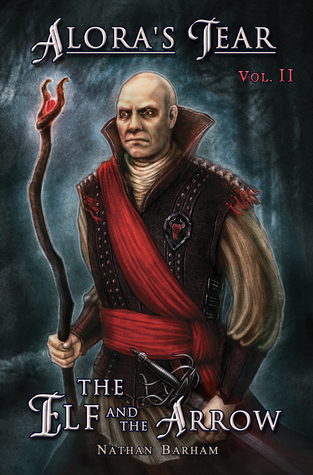
25236435I reviewed the first book of the Alora’s Tear series a while ago, and as the author was kind enough to send me a copy of the sequel, I thought I’d share my review here. Hint: I liked it even more than the first book!

First of all, if you read and enjoyed Fragments (the first book in the Alora’s Tear series), I’d highly recommend simply skipping this review and reading The Elf and the Arrow. It’s an excellent and very satisfying book, and probably best enjoyed without even the minor spoilers ahead! However, if you need a bit more persuading, read on.

Continuing the story begun in Fragments, The Elf and the Arrow picks up the story of the half-elf Askon of Tolarenz as he fights the war spreading across Vladvir, gaining both friends and foes in some unexpected places.

A couple of things struck me whilst reading The Elf and the Arrow and comparing it to its predecessor. First, it continues the strong writing – particularly when it comes to combat scenes and atmospheric descriptions – of the first book. Secondly, The Elf and the Arrow, whilst continuing the story, is something of a different beast, being frequently more complex, more political and throwing up more surprises.

That’s not to say that The Elf and the Arrow is a slow book, as there’s plenty of action, and plenty of twists and turns. Instead, it takes the story of Fragments and adds new dimensions, going deeper into the world of Vladvir and into Askon’s character. Of the former, we get fresh attitudes to the elves, as well as new perspectives on both the Norill (who break out of their role as mindless enemies in this book, becoming something far more intriguing) and several of Askon’s former allies.

Of Askon himself, we also get a new perspective. One of my favourite aspects of The Elf and the Arrow was his struggle with the fragment he now possesses, which adds an enjoyably surreal flavour to some of the action. More importantly, Askon is essentially battling his own emotions and anger every time the fragment gets out of hand, adding an extra dimension to a magical artefact that could have been far too powerful otherwise.

Overall, there’s a lot to enjoy here. Whilst The Elf and the Arrow really needs to be read as a follow-up to Fragments, it works well as a single episode of Askon’s story, providing well-paced action, surprises, more complexity and a particularly satisfying ending, whilst leaving plenty of bigger questions still to answer in later volumes.

Here Comes Spring…

…and a whole load of new fiction! (More on that in a sec.)

Spring is one of my favourite times of year. It’s also, these days, one of my busiest, as we’ve got guests to take care of, gardening to do, and – for the first time this year – a field full of new lambs! All that explains why I’ve been rather remiss in posting here, but fear not! I’ve still been writing, and I’ve got two new ebooks arriving within the next month.

The first, after its stint as serial fiction on Wattpad, is Servants of the Nexus. This will be appearing as a free ebook on Kobo, Kindle and whatever other sites I can wrangle within the next week. I’m also hard at work writing the sequel, so now’s a great time to jump into the adventure!

After that, I’ll be putting the finishing touches to ‘The Sky Below’, my pirates, floating cities and airships steampunk fantasy, the first in the Flight of the Lady Firene series. The series page will be going up very soon, and keep an eye on the blog for the cover reveal – which just so happens to be my favourite cover yet!

Finally, I’ve got another review or two coming very soon, as whilst I have been busy lately, I always keep a book (or two, or three) to hand!

Review: ‘Exile’ by Tom Stacey

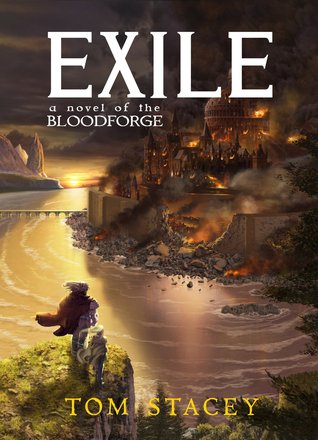
ExileCoverI’ve been reading more and more indie fantasy lately, and what I read, I like to review. ‘Exile’ is the latest book I’ve come across, and as it was an excellent read, I thought I’d share my thoughts here as well as on Goodreads. My thanks to the author for a free review copy.

In the heart of the Verian Empire, two young boys are about to awaken a dark horror, something not seen in their land for generations. An appealing simple premise, perhaps, but it’s one that sets a far wider-reaching and more complex plot in motion in Exile, an epic fantasy novel filled with war, rebellion and a cast of strong characters.

It’s the latter, in particular, that I found appealing. Too much of the ‘grimdark’ fantasy I’ve read of late has focused on characters that are deeply unpleasant. Exile’s main cast, on the other hand, seem to be essentially decent people, forced into horrible circumstances by their enemies. There’s plenty of violence and darkness here, and the characters don’t go unchanged by those things, but Beccorban, Loster, Riella and even Callistan all felt sympathetic to me, their worst excesses easily understandable given the events they go through during the course of the novel.

Exile’s biggest strength though, in my view, is its pacing. For a book of this length, there’s rarely a dull moment, yet it never feels rushed as the requisite fights and battles are well broken up by quieter moments. The prose, too, is strong (I came across only one major mistake, where an odd POV change halfway through a scene felt to have been left over from an earlier, unedited draft), meaning Exile is a surprisingly quick read, and the plot rarely flags.

My biggest issue with that plot was how long the reader has to wait for answers. That the characters and their country are facing a formidable foe is clear: just who that foe is, though, and what they want, is a long time in coming. In fact, they don’t even have a name until the book is three-quarters done, and I would have preferred some of this information a bit earlier in the novel.

Still, that’s really only a minor gripe in an otherwise impressive book. Exile is well-written, well-paced (particularly given its length) and with characters you can’t help but root for, as they struggle to overcome both their own demons and a powerful, often deadly foe.

‘Jupiter Ascending’ and Joy in Storytelling

Last night, I went to see ‘Jupiter Ascending’. I don’t want to talk about the film itself all that much; suffice to say, I thought it was a lot of fun, ridiculous and cheesy, frequently silly but with dialogue that didn’t make me cringe too often. What struck me most of all, though, was that it was a film that felt curiously joyful. It revelled in its silliness and was absolutely unashamed about the fact that it was pure fluff. And you know what? I sometimes feel like we need a bit more of that in the world.

It’s a topic that keeps coming up in the world of SFF literature, in a slightly different guise. There, the sub-genre of ‘grimdark’ is oft-discussed, and even as frequent conversations about whether it’s dead yet – or at least dying – crop up, it feels like every major fantasy publisher is trying to market their newest authors in the same mould. Where once everyone had to be ‘the new Tolkien’, now they’re ‘the new George R.R. Martin’, no matter how ridiculous the comparison.

It’s far to say that I’m not grimdark’s biggest fan. Clearly, it sells by the bucketload, and I keep returning to it out of hope (that I’ll find something that blows me away) more than anything, but nearly every book I pick up leaves me disappointed. It’s not just that I’m an optimist and like to see that reflected in my fiction: it’s that I came to fantasy, first of all, for its imagination and its capacity for escapism, and reading endless books filled with death, violence and abhorrent characters doesn’t really fit the bill (particularly when I can see enough of that every day on the news). Fiction should attempt to capture the world as it really is, of course, but I feel grimdark tends to forget there’s light to balance out the rest.

Back, then, to Jupiter Ascending. It’s a very silly film, true, but also packed with ideas and imagination. It felt, to me, to have that same spirit of adventure and optimism that fantasy from the 1980s had in far greater abundance than most of what’s being published today. There are definitely things in SFF from that era I wouldn’t want to revive (the fact that huge swathes of the genre were just Tolkien rip-offs, for one), but I’d still love to see some of that hopefulness return to the fantasy genre. Not every book has to be dark or darker, and not every fantasy world has to be a grim landscape populated only with broken souls. If I had to choose between that and pure, escapist fluff, I’d choose fluff every time.

This Writing Life: Learning Your Daily Rhythms

I’m aware, as I start to write this post, that the title above sounds rather woolly. ‘Daily rhythms’ sounds like it should have something to do with yoga, or fitness, or even digestive health! However, the more times my writing schedule suffers an upheaval, the more I realise that there are certain rhythms to the writing day, and that taking advantage of them can increase your productivity quicker than any other method.

Back when I had a job with set working hours, I also had a strictly defined writing schedule. I’d get up every day (or every weekday, anyway), have a coffee and set to work. I’d usually aim for 2000 words a day, which would take most of the morning and possibly spill into early afternoon. After lunch, I’d maybe do some editing, or write a blog post, or simply take time off – and after that, I went to my ‘day-job’.

And then came self-employment, with all its concomitant pleasures and pitfalls. These days, I can have anything between zero and ten hours of ‘day-job’ work to accomplish in the course of a day, seven days a week. There’s not always a set pattern to this, either, which means some early starts and long days, and some lazy days where I might just do some baking or laundry. Around all this, I have to fit in my writing.

For months, I struggled to find not the time, but the motivation. When you’ve been on your feet for eight hours and finally sit down at the computer, the last thing you want to do is write, even if it’s only 3 in the afternoon. I’d frequently find whole afternoons and evenings wasted, as I simply couldn’t find the energy to commit words to screen, and whilst I got a lot of reading done instead, my word counts were nowhere near where I wanted them to be.

Eventually, though, I came to a realisation. The number of hours I’d already worked in a day was irrelevant; what mattered was when I tried to write.

My preference, still, is to write first thing in a morning, and I do this when I can. However, on busier days, I’ve also found I have something of a ‘second wind’ from about 6pm, when I find my concentration much improved (possibly because, by 6, I’ve usually eaten my evening meal and so have a lot more energy). Trying to write in that afternoon free-time, around 3pm, has turned out to be almost pointless. No matter what I’ve spent the rest of the day doing, I’m nearly always tired and lacking in concentration, which means I usually turn to reading instead.

That little switch – from trying to write at 3pm to actually writing at 6 – made a huge difference to me. Suddenly, I was able to sit down at the computer and start writing straight away, rather than wasting time on the internet for half an hour before giving up entirely. Working out when you have the most energy and the best creative concentration is absolutely vital for anyone who’s trying to fit writing around a busy work life – it’s the most consistent way I know to increase your word counts without feeling like you’re pulling teeth!

Epic Reads: ‘Forge of Darkness’ by Steven Erikson

I’ve blogged a lot recently about various bits of writing news, but it’s been a while since I just talked about my first love: books. A few weeks ago, I mentioned that I was planning to start a new series of posts, talking about ‘epic reads’ – in other words, longer books that are far beyond the word counts of most published fiction.

I have a real fascination with these weighty tomes. For a start, fantasy – more than any other genre – is absolutely littered with them. Some series are even book after epic book, and run to millions of words when taken together. Whilst there’s something of an expectation that fantasy novels will be longer than the norm, it takes a skilled writer to really pull that off and to keep the reader invested in a story that might take years to tell.

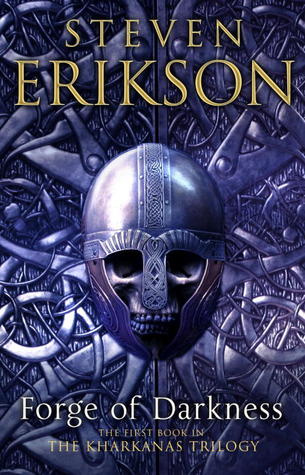
16280101My first ‘epic read’ in this series, then, is Forge of Darkness by Steven Erikson. Erikson is best known for his Malazan Book of the Fallen series, which – at 10 books and over 11,000 pages in paperback (thank you Wikipedia!) – came to an end in 2011. Since then, Erikson has started a new, related series, the Kharkanas Trilogy, which is a prequel of sorts to his earlier work but also stands alone.

As this isn’t an official review, I won’t relate the plot of Forge of Darkness here. Goodreads has the usual blurb, along with a good set of reviews. Instead, I want to talk a bit about some of the things Erikson does in the novel, both the highlights and things which are perhaps a bit more problematic.

First of all: just how epic is Forge of Darkness? The quick answer to that is ‘very’! Erikson has weaved a plot of extraordinary complexity, with a vast cast of characters, many of whom provide their own POV. It’s quite clear, too, that plotting really is where Erikson excels, and the story never gets away from him. Whilst Forge of Darkness is a long book, virtually every scene pulls its weight, adding some new detail of plot or character that adds to the overall tapestry. Remove even a single strand, and the story loses some of its vital depth – every piece of the book really is necessary to understand the whole.

Erikson is also a very skilled writer. Forge of Darkness is, at times, almost poetic, and the prose flows perfectly. However, this is something of a double-edged sword. Poetic is one thing, but this is a novel brimming with philosophies and musings on the way the world works. This is, at times, as dry as it sounds, and I sometimes found myself wishing certain characters would stop thinking and start doing.

Still, a certain level of thoughtfulness is perhaps needed with a book of this length. Nothing but action would be just as tiring, and – as is the case with many long, complex books – the pace here is generally slow. As a result, we get a chance to get to know a good number of the characters, despite the fact there are so many of them; those that blur together in the early chapters generally become more distinct as the story goes on, as we get a better sense of their personalities, motives and histories. It’s difficult to pick out a single protagonist, or even a handful of them – which might bother some readers – but Erikson does a good job of explaining each new character, often with surprising subtlety.

And this is a subtle book – for the most part. I felt Erikson’s deft storytelling fell apart in just one or two instances, where moments of extreme violence were suddenly thrown into the story. Whilst I understand these moments are intended to show how Kurald Galain (the world of Forge of Darkness) is starting to fray, they felt unwieldy and out-of-place against the otherwise steady pace. This is, I’m aware, partly a personal preference: I’m becoming increasingly disenchanted with violence in ‘grimdark’ fantasy, and its inclusion here spoiled sections of this book for me to the point where I considered not finishing it at all.

Perhaps my biggest issue with Forge of Darkness, though, was its seriousness. There’s hardly a single joke or moment of lightness in the entire book, which very little to leaven the grimness. The serious tone, along with Erikson’s baroque writing style, makes it feel almost po-faced at times, with some scenes coming off as unintentionally hilarious. I’m not a great fan of ‘funny’ fiction (now there’s a subjective term!), but for a book of over 900 pages, Forge of Darkness is so, well, dark that it occasionally verged on being hard work.

That’s not to say I disliked the book, though. Overall, Forge of Darkness is an accomplished work, by one of the most impressive writers working in fantasy at the moment. For writers, there’s a huge amount to learn from his stories, particularly with regard to dealing with huge casts of characters and plot complexity. For readers, this is a book (and a series) to really get your teeth into, whether you’re already a Malazan fan or not – and when it comes to the darker variety of epic fantasy, Erikson’s work is some of the most intelligent and immersive fiction around.

Newsletter Time!

I feel a bit like every post I make here recently is announcing some big new change, or even a new book. Today, I wanted to mention one of the key reasons I decided to make the switch from just a blog to a full-scale website: the newsletter.

I’ve found myself increasingly enamoured with the newsletters of other writers in recent weeks. It’s a long time since I’ve kept up with any writing blogs, and everything on Twitter moves so fast. A weekly or monthly newsletter, then, is the perfect way to find out about the new releases and miscellaneous news of my favourite authors, and that’s exactly why I’ve set up my own.

If you’re a blog reader, then, and you want to keep up-to-date with my latest news – as well as get fiction excerpts, ebook discounts and cover reveals before anyone else – you can join my newsletter HERE. Whilst I tend to blog about writing, the newsletter will almost exclusively be about my fiction (with possibly the occasional pet picture or recipe thrown in!). I’ll be sending them out roughly once a month – now I’ve just got to go out and do things to fill them with!

SERVANTS OF THE NEXUS now on Wattpad!

It’s been a quiet few months for me as far as fiction releases have gone, but I always knew I wasn’t going to get far into 2015 without publishing something – and right now, that something is ‘Servants of the Nexus’, the first story in my Wayfarer Chronicles, which I’ll be adding to throughout the year. First of all, here’s the fabulous cover:

wayfarers1

There are a thousand thousand realms in the Nexus. Someone has to protect them from themselves – and each other.

As a Wayfarer, one of the immortal Kin, it’s Saenumandua’s job to police the illicit sale of information between worlds. Trouble is, only another Wayfarer could do the selling, and rogue Kin are dangerous beasts.

When one of them breaks into Saenu’s home, she’s left chasing a trail of clues that leads her to the city of Howl, a place of lumbering automatons and neon streets. With the aid of fellow Wayfarer Cam – and his guardian angel – Saenu must take back what was stolen and face an old foe, one who leaves nothing but devastation in his wake.

To get the ball rolling, I’ve decided to post ‘Servants’ on Wattpad, a great site for free, serialized fiction. I’ll be putting up a new chapter ever Friday for the next nine weeks, at which point the novella will go up on Amazon, Kobo and similar.

If you’re already on Wattpad, have a read, and perhaps stop by and say hello – and even if you’re not, you should still be able to read the story. Free fiction! What’s not to like?