Content Is Not My King

There’s a saying in the online world that, if you’ve spent much time around marketing blogs, you’ll probably have heard: content is king. It’s usually attributed to Bill Gates, some time in the mid-90s, but for the purposes of this post, its origin is irrelevant. Instead, I want to talk about the idea of ‘content’, and why I think it’s a pernicious one, particularly if you’re interested in a creative lifestyle rather than simply making money online.

The phrase ‘content is king’ is most frequently used in blogging terms i.e. you need plenty of quality content on your blog if you want it to succeed financially. That, in its most basic sense, I wouldn’t disagree with. However, in recent years, I’ve seen the word ‘content’ bandied around in a number of other spheres. Content is no longer just what you put on your blog: it’s your fiction, your music, your podcasts, your artwork, your photos of your cat. Again, at its most basic, all of this is ‘content’ – but lumping it all together creates a problem.

You see, not all media is created equal, or at least I don’t believe it should be. That novel you’ve spent a year slaving over isn’t equivalent to someone’s newest Tumblr post; a portrait done in oil paints by a skilled artist isn’t equal to that Vine you just filmed of your cat knocking things over.

These are exaggerations, of course, and things become more difficult to compare, let alone place a value on, as they either become more similar or when they’re in completely different media (how do you decide whether a masterful painting or a classic novel has more value, for example? The answer is always going to be subjective). This isn’t about deciding which is ‘better’, though, but rather about believing not everything is the same.

And that’s where my problem with content comes in. As creators, we’re constantly hearing this ‘content is king’ message, and being told that we’ll only be more successful if we keep producing more, more, more. Trying to follow this mantra, though, doesn’t take into account either the personal value we place on our art, nor the time that’s gone into it; the world would be a far poorer place if every piece of art, music and literature was suddenly replaced by low-grade ‘get rich quick’ blog-posts and tweets, in a misguided attempt to produce more ‘content’.

Maybe this sounds a bit snobby, but I don’t mean it to be – there’s undeniably a place in the world for business blogs and cat videos, after all. I’m also well aware that some of the media I consider an important part of my life would be considered trash by others, and vice versa. The important thing, really, is that whatever medium we create in, we take the time to think about what we place value on and why, and to make sure that the rush for ‘content’ never overwhelms our desire to make art, in whatever form that takes.

More is not necessarily better, quantity shouldn’t rule over quality, and sometimes you just have to focus on the passion that’s eating away at your heart, no matter how long that takes, or how much ‘content’ you could have created in the meantime.

The Part-Time Writer: Priorities

In my last few posts, I talked about why you might want to be a part-time writer, but today it’s time to get into the meat of really doing it: of committing to being a writer, whilst knowing you have a job to go to, kids to look after, voluntary work or hobbies or social events that need your attention. Because all those things are also important, right?

Of course they are. The trouble with a lot of writing guides I’ve read is that they espouse a rather simplistic message. If you want to be a writer, they say, you will WRITE. The harshest of these guides suggest that if you don’t write, then you never wanted to be a writer at all.

To a certain extent, this is something I agree with. Going for weeks, months or even years without writing anything, whilst continually talking about writing? That really doesn’t make you a writer. Sorry, but it’s true. However, suggesting you need to write every spare minute of every day if you’re going to make it as a writer isn’t true, either. Being a part-time writer is all about finding balance in your life, and the first thing you need to set are your priorities.

This, I admit, can sound a little woolly. When we start talking about priorities and motivation and inspiration, all things which make up a lot of any creative lifestyle, we risk descending into a fuzzy world where the work would get done, if only the Muse would co-operate (or maybe if only I didn’t need to rewatch an entire season of Farscape this weekend for the fifteenth time. I tend to find most descriptions of ‘the Muse’ a load of crap, because frankly, your words come out of your own head, and you don’t need to offer libations to some mysterious inner creature/external force of the universe in order to unlock them. But I digress.)

Fuzzy or not, though, every part-timer needs to work out their priorities. For me, this is a fairly simple process. There are things, after all, that just must be done. I have to work and thus earn a living. I have to eat and exercise. If you’ve got kids, you’ve got to feed and clothe them, too, or maybe you’ve got relatives to care for, or pets. Either way, these things will take up a certain amount of your time, and whilst you can try to delegate or maximise your efficiency all you want, that’s never going to completely go away.

Where priorities really become important, though, is in regard to the remainder of your time. You’re home from work. You’ve eaten. You’ve walked the dog. Now what?

It can be all too tempting at this juncture to turn on the TV, or reach for a book, or watch three hours of cat videos on YouTube before you fall into bed. Quite frankly, there are days when I can’t find the energy to do anything else. The rest of the time, though, when these temptations sneak in, I start asking myself questions. Which is more important to me: finishing this book or watching another episode of Location, Location, Location? (My love for home buying/renovation shows knows no bounds.) Am I going to kick myself if I don’t get this chapter finished this week? Are people really going to remember my extreme prowess at Minesweeper after I’m dead?

Okay, maybe that sounds a bit drastic, especially that last one (I’m terrible at Minesweeper), but there are times when you really have to remember what your priorities are. Maybe the most important thing to you right now is volunteering at a soup kitchen, or redecorating your living room, or raising alpacas, in which case you need to go out and do those things. Maybe, though, it’s writing that’s more important to you than anything else — which means, when the lure of the TV, book or video game is calling, you have to be strong. You have to write instead.

I realise this isn’t always as easy as it sounds. How do you choose between an obligation to a family member or your community, and your personal goals, for example? Explaining your priorities to those around you can also be hard, particularly if your loved ones just don’t see value in your writing. However, having some idea of your own priorities is absolutely valuable for part-timers in all fields, so that when distraction and weariness set in, you can think about what you most want out of life, and immediately know how to spend your time. And if one of those priorities is writing, and you put aside everything else to do it? That’s when you can call yourself a writer.

The Part-Time Writer: The All-Round Part-Timer

In my last post, I focused on a whole host of reasons why you might want to remain a part-time writer, and why immediately dropping the day-job the minute you start a novel probably isn’t the best of ideas. I realise, though, that might be something of an unpalatable thing to hear for a lot of budding writers. Everyone wants to believe that becoming a writer will solve all their problems, turn them into a superstar, or at the very least pay off their mortgage — anything approaching a reality check goes ignored. However, even if you’re chomping at the bit to ditch the day-job, I’ve got one last option for you: becoming an all-round part-timer.

Let me start with a story. When I left university, close to a decade ago now, I hadn’t a clue what I wanted to do. I had, quite frankly, a completely useless degree, and short of going into a life of academia, I couldn’t really see what I was going to do with my BA. Still, I had a degree — any kind of degree would help me get a job, right? Wrong. Not only was the world on the verge of a major recession and the jobs market in turmoil, at least in the UK, but I quickly realised a 9-5 office job wasn’t going to suit me. Instead, after a depressing few months of unemployment, I ended up with a Christmas job in a bookshop, before going on to work in a library.

This, then, is where the writing comes back in. The library I worked in was staffed almost entirely by part-timers — my first shifts were all late in the evening, and although I later switched to more mornings and afternoons, I was never working more than 30 hours a week. Whilst that wasn’t ideal in some respects, it did come with one major advantage: it gave me time to write.

And not just any time, either, but set hours every week, which I could easily schedule around my day-job. I don’t think I’ve ever been as productive as I was for those few years. Not only did I write a 120k word novel in 3 months, but I continued to blog, to write short stories, and to find time for reading, gaming and all my other hobbies. It was, put simply, rather brilliant.

It’s easy to see why I advocate this lifestyle to those who can manage it. There are obvious drawbacks, of course, chief amongst them being the reduced wage of a part-time worker, which can seem particularly onerous if you’ve come from a full-time job. In theory, you can top-up that wage by making money from your writing, but given the vagaries of the publishing industry, that isn’t always as easy as it sounds. It can be difficult, too, to explain to family and friends both why you want to work part-time, and what you’re doing the rest of the time. Not only will they question how much money you’re making, but writing time simply isn’t held sacred by non-writers — of course you can pick up the kids/run an errand for me/attend this social gathering, because you’re not at work, are you?

Still, going part-time is one option I think all writers should consider. The stability of a salary, plus the social interactions with clients and co-workers, is a perfect accompaniment to having more writing hours and the ability to create whatever you want, without the threat of starvation hanging over your head.

Whether you’re a part-time writer through choice or necessity, though, many of the techniques and skills you need are much the same. In the next few posts, I’ll be diving into tricky areas that all part-timers need to master, from setting goals and priorities, to managing your time — master these, and suddenly the part-time life becomes a lot easier!

The Part-Time Writer: Keep the Day-Job

In my opening post, I talked about being a part-time writer, and about all the other writers like me, who have a day-job, or a family, or are self-employed. For many, that life is one they eventually want to leave behind (well, maybe not the family!), but today I want to talk about the alternative. About why you might actually want to be a part-time writer, and why keeping the day-job, no matter how tedious that sounds, might actually be the best thing you’ll ever do.

Let’s get one obvious point out of the way first: you might want to be a part-timer because writing is just a hobby. Well, I say ‘just’, but a hobby or several can be a huge — and hugely rewarding — part of your life. If you aspire to write only for yourself or for friends, to only ever write fan-fic, or to just keep a blog tracking your progress in knitting or pedigree goat breeding, then who cares if the wider world thinks you’re limiting yourself to being an amateur? If you’re happy, enjoy your writing, and don’t have any interest in a wider audience, then I say stick to your guns. Be an amateur, a hobbyist, the part-timer of part-timers, and be proud.

But maybe you’re angling for more? Maybe you want to get paid for your writing, to have thousands of readers, to have your book up there on shelves — or on the Amazon store front, these days. You want to be a professional writer — and yet, sometimes, there are very good reasons to remain a part-timer anyway.

First of all, another obvious point: you might really like your day-job. Maybe you’re a teacher, or a scientist, or a doctor, and nothing in life can ever come close to the fulfilment that brings you. Maybe you mow lawns or stack shelves or unblock drains for a living, and you love that just as much as writing. In all these cases, keeping the day-job is a given, because why give up something you enjoy so much? Even if you hate your job, though, having a world outside your writing can be more beneficial than you might imagine.

There’s the money, for a start, something that needs to be considered even by those who write solely for their ‘art’ and find the idea of financial remuneration somehow sordid. Whether you’re comfortably off or just scraping by, there are very few writers who can dive straight into the deep end of publishing and make a living straight away. Having the safety net of a monthly income, or even just a pot of savings, takes the worry out of writing, particularly if you’re only just starting out. Not needing to make money from your writing means you can write entirely what you want, without worrying about the market, or potential readers, or which publisher to submit to — and trust me, those early days of freedom are an absolute gift. Treasure them.

Even if money isn’t an issue for you, a day-job can be vital. Writing can be a very lonely business, after all, and no number of weekly writing groups or days spent in coffee shops will ever entirely make up for all the hours spent interacting with customers, clients and colleagues. Even if you’re an introvert, as many writers are, entirely locking yourself up in your own head isn’t always healthy — you need to know you’ll actually be happy working alone for an extended period of time before you give up an outside work environment. Stimuli, too, can be harder to come by when you’re writing full-time. Any kind of work, no matter how mundane, exposes you to situations, people and ideas you can use in your writing (moreso if you have a really fascinating job, of course); once you’ve given up your day-job, those are all things you have to make a lot more effort to go out and find.

And what about your health? If you’re healthy now, that might be one issue you’ve never even considered. Swapping one desk job for another won’t make a colossal amount of difference, of course, but if you have an active job now, you need to remember you could well be letting yourself in for a world of back pains, hand complaints, and just the general lack of fitness that results from being able to sit around and eat snacks all day (depending on your personal level of willpower, of course!).

Maybe this post seems overly negative — if it does, I’m not going to apologise. Receiving the reality check of ‘don’t quit the day-job’ is far more valuable before you’ve actually done it, rather than waiting to find out you’ve just dropped yourself into a life you’re not prepared for. On the other hand, though, maybe you’ve considered all these potential hazards and are still shaking your head. Maybe you’re sick and tired of having a day-job and can’t wait to quit it for good — but before you do that, there’s one last option to consider, a perfect answer to all these conundrums: being a part-timer all round. That’s what I’ll be covering in my next post.

The Part-Time Writer: An Introduction

When somebody says, “I’m a writer”, what do you picture? Maybe it’s a millionaire knocking out bestsellers every three months, getting them all optioned by Hollywood; maybe it’s a starving twenty-something living in a Paris garret, writing a single line every day of their Great American Novel. Or maybe, just maybe, it’s an office worker hammering out chapters in their lunch break, a mum working at the kitchen table whilst her kids are asleep, a librarian or a doctor or a teacher, getting up an hour early every morning to type a few bleary paragraphs before work.

The truth of the matter is that very few writers, professional or amateur, write fiction full-time. Many have day-jobs they dream of leaving. Others have a job they love, and writing is just a hobby. Still others write both for work — ad copy or magazine articles or blog posts — and as a passion in the evenings. For every job you can think of, there’s probably a writer out there doing it, whilst spending their free time (and maybe some of their work time) thinking up plots and characters, scribbling notes, and wishing they were at their keyboard. The one and only thing they all have in common, whether they keep their day-job voluntarily or out of necessity? They write.

I’m just one of these writers. My ‘day-job’ (or maybe that should be ‘first job’, as it’s not one with regular hours) is running a B&B with my partner. Some days, particularly during the summer, writing seems like a distant dream; others, I have nothing to do but write. I’ve asked myself time and again whether, should my writing career ever take off, I’d give up my day-job entirely, but it turns out that’s not an easy question to answer — until it actually happens, anyway.

So, for now, I’ll continue to write in my spare time, be that full days or snatched half hours. I will, like the majority of other scribblers out there, be a part-time writer — and that’s what this new series of blog posts will be about. There’ll be tips and tricks, things I’ve discovered for myself or picked up elsewhere. There’ll be techniques for writing more, writing faster, and making better use of your time. There will also be a few posts about why we do what we do: about motivation and passion, about the pleasure (or not) of writing, and about what makes this a life so many of us just can’t give up.

Because, for now at least, I’ll continue to be a part-time writer — and if you are, too, I hope you’ll join me for the ride.

TO DROWN IN DREAMS Now Available!

I mentioned in my last post that I’d been editing the second book in my Flight of the Lady Firene series, and sure enough, it’s now available on Kindle. Here’s the blurb:

Arjipur: a jungle haven built by pirates, exactly the sort of place Fleet Manteios and her brother Daryus should feel right at home – and somewhere they could make their fortune, if half the city wasn’t out for their blood.

Not only has Daryus made enemies by dabbling in the trade of the semi-magical drug gilgesh, but he and Fleet are about to run into an old enemy. Caria Maharin is an enforcer and head of the notorious Midnight Division – and she’s also the former owner of the airship Lady Firene. Nor is she the only one with an interest in the ship, or its crew: Arjipur has a new admiral, commandeering airships in the name of a war against an unknown enemy, and he’s got the Lady in his sights.

As Fleet fights to protect her brother, her ship and the city, she’s faced with a conundrum of her own: there are two very different men in Arjipur, both dear to her, and she’s going to have to decide where her heart lies.

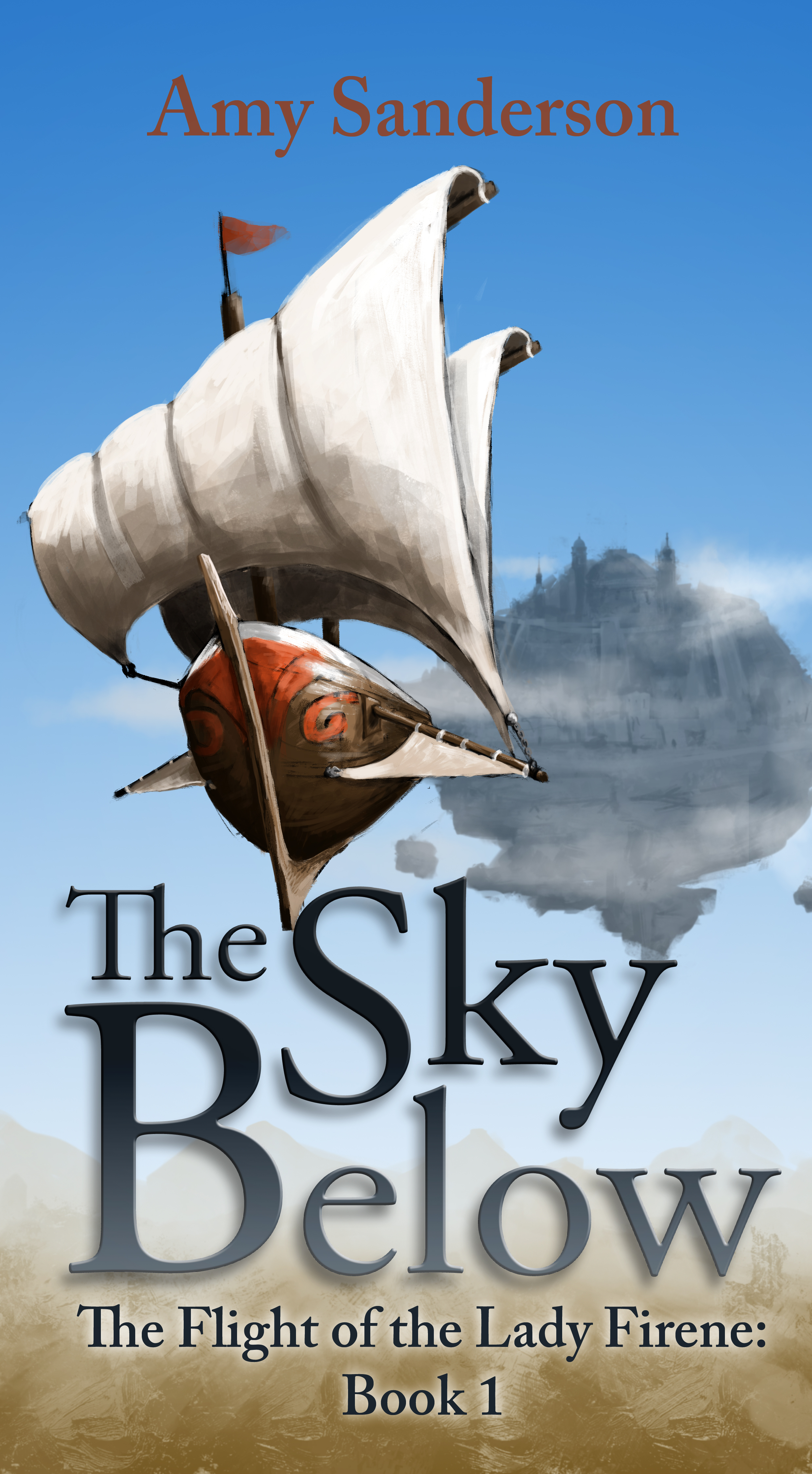
To Drown in Dreams small coverSteampunk fantasy adventure! Airships! General shenanigans! What more could you want? Oh, a link to find it on Amazon? And not just that? A free book? That second link, incidentally, is the first book in the series, and if you happen to visit this blog entry between the 28th of October and the 1st November, you’ll be able to download ‘The Sky Below’ absolutely free. I say again, what more could you want?!

Less excessive use of wild punctuation? Okay, I’ll give you that one.

This Writing Life: Writing Every Day… Or Not

I’ve long been a proponent of writing regularly, of keeping a schedule no matter how busy the rest of your life might be. Maybe that’s writing every weekday, or every weekend; maybe that’s just one night a week, jealously guarded. In any case, having that routine allows you to write reliably and steadily, to set deadlines, and – importantly – to finish things. However, in the past I’ve also accompanied a regular schedule of production with time off, anything from a day or two each week to longer periods, time to think and relax and sort of breathe, away from whatever I’m working on.

This year, though… This year, I decided to try something different.

Starting on the very first of January 2015, I set myself the goal of writing 1000 words a day, every single day of the year. For someone who was also running a new business, keeping animals and attempting to have just a little bit of a life, it was an extraordinary target – but, for the most part, I’ve succeeded. Between the start of the year and the middle of October, I wrote every single day bar one, and whilst on many occasions I didn’t reach that 1k, my overall word count ultimately averaged out at my goal.

It has, without a doubt, been incredibly hard, but also incredibly rewarding. Producing so many words over the course of 10 months or so has been not only a boost to the number of books I’ve been able to self-publish, but also very exhilarating. There’s nothing quite like writing, and writing at speed, to make me feel endlessly satisfied; that abundant productivity and creativity is thrilling like nothing else (well, without leaving the comfort of your desk, anyway!).

You might have noticed, though, I mentioned ‘the middle of October’ above. That’s because, in the last week, I’ve made the decision to drop my daily target altogether – in fact, for the last couple of days, I haven’t written anything at all. (Funnily enough, what I expected to be a liberating decision is one I’ve barely noticed, simply because I’ve been busy with other things; and, perhaps, because writing is never far from my mind, even when my fingers aren’t on the keyboard). So, what happened?

Well, for a start, that daily writing schedule, and particularly pushing for 1000 words each time, was frequently disruptive to everything else in my creative life. For months, I’ve ignored social media, this blog, promoting my books, and all sorts of other miscellanea. For a long time, that didn’t particularly bother me, as I felt it was a sacrifice worth making, and I might have gone on almost indefinitely; in the end, it was two other factors that forced my hand.

One was, quite literally, my hand. I’ve suffered from RSI in my right hand, wrist and arm for years, and whilst the general routine of writing every day didn’t seem to exacerbate it, recent stints of concentrated editing seem to have been particularly damaging. Secondly, that editing was a problem: trying to edit multiple books, alongside writing 1000 words a day, has been more of a challenge than anything else I’ve attempted this year. In the end, I knew I needed to edit in order to meet my publishing deadlines, but that meant I frequently fell behind with my word counts, and knowing I wasn’t able to claw my way back to my goal was more disheartening than helpful.

So, I’ve dropped the schedule, but I’d still say it’s been worth it, as an experiment if nothing else. I think I really just wanted to prove to myself that I could do something like this – and I have. Whilst I would, in a perfect world, have kept up my goals until the end of the year, I still feel an amazing sense of accomplishment over how much I did achieve, and I’ve been pleased to find just how much writing time I can tease out of a day, every day, even when I feel otherwise overwhelmed.

As I said, then, an experiment, and a successful one, even if ended a little early. In future, I’ll still aim to write far more days than not, and to keep up a schedule whenever possible – but also, for my health and my sanity, I’ll remember to take days off now and again, that editing is just as important as writing, and that, when I want to, I can accomplish anything I set my mind to.

THE SKY BELOW Now Available!

I’ve been holding off on my latest release for a few months now (I think I started mentioning it back in April), waiting until I had the second in the series almost complete. Finally, though, it’s time to share my newest series, a steampunk fantasy adventure titled The Flight of the Lady Firene. Each of the books will work roughly as a standalone, whilst continuing key characters and a few plot strands across the entire series. Below are the details of book 1, ‘The Sky Below’:

Flyingship2My name is Fleet Manteios and I’m a pirate. It’s a cut-throat life, sure enough, but it gives me the one thing I crave after a stuffy upbringing and a disastrous arranged marriage: freedom.

When Fleet and her brother Daryus raid the airship of a rival pirate, the last thing they expect is to end up fleeing for their lives with only a single trinket to show for it. A return to the floating city of Numara in the hope of a safe haven also turns sour, as the city comes under siege from within. Shape-shifting wolves, sea monsters, and strange murders committed by even stranger creatures plague Numara, and Fleet’s ‘trinket’ seems to be at the heart of it all.

Soon, she’s attracting the wrong sort of attention from every quarter: vengeful pirate captains, priestesses, her estranged husband – and the mysterious Shan, who knows more than he’s letting on. As Numara fractures around her, Fleet is left facing the possibility that the item she carries is the greatest threat she’s ever known, and it’s going to tear the city apart.

‘The Sky Below’ is currently available for Kindle only (which you can find here), but that does mean if you have a Kindle Unlimited subscription, you can read for free. If you’re not a Kindle reader (or you just fancy a free copy!), get in touch, as I’m happy to send out review copies of the book in other formats.

More Book News Than You Can Shake a Stick At

It’s been a busy summer for me so far, between actual day-job work and putting together as many ebooks as I can possibly squeeze out in the second half of the year. However, I haven’t been remiss at attempting to take over the world– Ahem. Extending my existing catalogue to as many places as I possibly can. Here are a few details:

First up, ‘The Wanderer’s Word’, a semi-historical fantasy short story.

The Wanderers Word for web

Where king and his conquered subjects collided, only trouble could follow.

England, 11th century. William of Normandy has taken the crown and is travelling in procession across a land he now rules, but which continues to resist him.

Alden, newly widowed blacksmith of a village barely worth a name, has greater cares than a single king. His world fell into tatters the night he lost his wife and child, and now his only concern is to protect their grave.

Except Alden’s family were denied a Christian burial, and the site he chose instead is under threat from the king’s men. He’s not the only one who would see that ancient and hallowed place protected, but if Alden is to gain their aid, he’s going to have to make a deal with the Old Spirits who still haunt the land – and he might lose more than he knows in the process.

The Wanderer’s Word is a 6000-word short story, and a glimpse of a historical England that never quite was – but easily could have been.

There’s the blurb, and here are the links. This one is Amazon only, for the time being, which also means you can pick it up via Kindle Unlimited, if you’re so inclined, at Amazon US and Amazon UK.

I’ve also been adding my first YA fantasy novel, ‘Sanguine’, to a few new stores. You can now find it at iTunes, and at the subscription services Oyster and Scribd.

Happy reading!

Joining the 21st Century

It feels almost archaic, somehow, to talk about joining Facebook in a world that seems to have so comprehensively moved on to Twitter and Instagram and whatever else the flavour of the month social media is (probably not Twitter and Instagram any more, to be honest!). However, after being on Facebook for years in a personal capacity, I’ve only recently embraced the site as a means of sharing book and writing news.

As a result, I’ve now got a new, official Facebook Page, where I’ll be posting writing updates, cover reveals, tidbits of story and anything else that takes my fancy. You can find it HERE.

Remember, all the very latest news and details of offers, contests and the like are in my monthly newsletter, but if you want a quick and easy way to keep up with my fiction, and you’re already on Facebook, now you can find me there as well!