First Fruits of the Veg Patch

Ok, that title is a little bit misleading: we’ve actually had a selection of lettuce, pak choi, radishes and herbs from our newly created veg patch this year. However, nothing really compares in impressiveness to the courgettes we’ve managed to grow. Here’s my photographic proof:
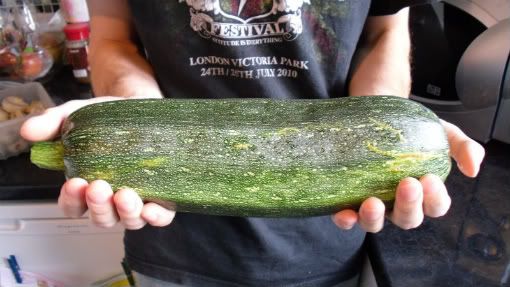
This is the size at which our first courgette stopped growing, so we decided to pick it. There are currently two more on the plant at about this size, with the potential to get even bigger, as well as a few smaller ones. And this is from a plant that was grown straight from seed in the veg bed, about three months ago, after all the courgette seedlings I tried to grow in the house died off. Impressive stuff!

In the rest of the patch, things aren’t looking quite so impressive, unfortunately. The lettuces, after a large and healthy crop, are starting to look a bit worse for wear. We’ll use as many as we can, but a few may end up on the compost heap. Our garlic plants, which looked so good earlier in the year, are also looking a bit ropey now. As for squashes and ball courgettes: two of the plants are growing well but only have a single squash/courgette on them apiece; the last squash plant is doing much better, with half a dozen slowly growing yellow squashes (I have no idea what variety there are, but they look good).

What have we learned from our veg growing experiment so far? Well, grow courgettes, to start with! I’d be tempted to simply start all my courgettes and squashes outside next year, as they seem to have done better that way. I also think I’d stagger each crop better, perhaps planting only one row of each veg at a time, then planting a second a few weeks later. I’d probably also uproot any veg that isn’t doing well: we’ve tried spinach twice now, and both times it’s been absolutely useless (tall, spindly, tiny leaves), so I should have just pulled it up as soon as I realised it wasn’t doing very well, rather than leaving it a few weeks to see if it would improve (it didn’t).

So far, growing veg has been difficult in some respects and very easy in others – but always interesting. And it’s a real pleasure to be able to eat the results!

The First 10k Words

I said a couple of posts ago that I’d started a new novel and would try to keep up to date with talking about it here – so here goes. This is my progress so far on the novel known only as ‘Dust’.

That works out as about two weeks’ work, so I’m very happy indeed, as my aim is to write about 5k words a week. As for content: I’ve finished five of the first six chapters (six POVs, one chapter for each character), and have about reached the point where I need to take a step back and work out what’s going to happen next. How long that will take, I don’t know, but this was always the danger when I started writing so soon. I simply don’t know what’s going to happen in the middle of the novel, so I can’t keep writing until I at least work out the next step.

As for the rest of my writing: I’m up to the query/synopsis writing stage with my recently edited novel. I’ve never heard of a writer who actually likes this stage, probably because it both looks easy but is actually remarkably difficult, and because it can mean the difference between your novel been accepted and rejected. No pressure, then.

I’ve also submitted one short story this week and sort of finished another. I say ‘sort of’ because this story became far more complicated and baffling than expected in the process of writing it, and I’m not sure what to do with it next. It’s not a good sign when a story confuses even the writer… But I always used to get the best marks in university essays when I wasn’t entirely sure I understood what I’d written!

How is everyone else’s writing going?

This Writing Life: A Kick up the Backside from the Universe (aka Making Writing a Priority)

I tend to keep this blog fairly impersonal, at least as far as anything beyond writing goes. It’s been quiet here this week though, and I wanted to talk about why – and about how, after a few weeks of slow progress, I’m trying to get my writing back on track.

You see, about six weeks ago now, I decided I was going to try for a new job. I duly filled in the application, then heard that I would be getting an interview. In the month gap that followed, I tried to keep writing but, as is ever the case when life gets turned upside-down, it was much more difficult than usual. As I mentioned in my last post, I started working on my next novel, which was partly a means to keep my writing moving at a time when I was finding it increasingly hard to concentrate (it worked, for a while, and I have around 8k words of that novel now).

And then the interview came around. For about a week before, I wrote very little at all. The interview itself came and went and, honestly, I didn’t feel it went particularly well. By sheer coincidence though, a few hours after the interview, I received an email relating to one of my short stories, saying it had been shortlisted for an anthology. Now, I sent that particular story out months ago and had given it very little thought since. Whether the story ultimately gets into the anthology is fairly irrelevant right now (although I’d love it if it was chosen, of course). I count myself an atheist, and one who doesn’t believe in fate or karma or much more than coincidence, but this particular coincidence felt like a cosmic kick up the backside. It was telling me, if you haven’t already guessed, that I should stop worrying about interviews and jobs, and simply get back to what makes me happiest: writing.

Because, through all this, writing has been the once constant and the one thing that always does make me happy. It can be easy to get caught up in worrying about money and jobs and careers. Sometimes you have to worry about those things. But you also have to prioritise the things that matter the most, be that family, or friends, or art in any form. It can be a hard lesson to learn, especially when it takes rejection in other spheres (like an interview) to learn it, but it’s an important lesson too, and one which is only going to make me work harder on my writing. It is, after all, what I want to do, not something I’m only doing for the money.


And So It Begins…

…my new novel, that is. Despite everything I’ve been telling myself about waiting to make a start on this new project, despite all the other things I really should get out of the way, despite all the extra research and planning I should do first… I have begun. And it feels great.

So far, I’ve got the first 1000 words of what will probably stretch to about the 120k mark. It’s a slow start, but one I’m pleased with. As for planning, I have a good idea of what will be in each first chapter for each of the POV characters (I’ve actually started with what I think will be the third chapter overall) and I know the beginning of all six (six! Yes, I know, this may be a vast and horrible mistake…) character arcs. And for the rest… Well, there’s that abyss I mentioned a couple of posts ago.

There’s nothing much to report at this stage, but I plan to post fairly regularly about this novel, including both what’s going well and what’s going wrong – and I do expect things to go wrong. They always do. Where would the fun be if they didn’t?

So it’s a new novel for me, and a slow but steady start. If you’re a writer, how is your latest work going? Comments, as always, are welcome – I know how much writers (including me, which is the whole point of this blog) love talking about their work, and I love to hear about it!

Photos: Northumberland

After my last picture post, featuring two shots of the beautiful island of Lindisfarne, I wanted to show a couple more from the Northumberland holiday. The first is, actually, another from Holy Island. Down on the shore near the castle, people had been building these little stone sculptures, which were both simple and very striking. This one was my favourite:

.

On another day, we took a wonderful boat trip out to the Farne Islands, which are a haven for nesting sea birds. After we got over the smell (which was unpleasant but fairly easy to get used to) and the attacking terns (which were defending their chicks, which had a bad habit of wandering aimlessly over the paths), Inner Farne was a spectacular place to take photos. Out of the ones I took, this one is definitely my favourite:

What can I say but… Puffins! They’re fantastic little birds, amusing and attractive in equal measure. They also seemed supremely unconcerned about all the people wandering around on their island, and were quite happy to pose for photos.

That’s it, for the moment, for my planned photo posts. Unfortunately, getting back to novel writing is going to leave me without much spare time for photography this summer, but the holiday was a great chance to remind myself just how much I love being behind the camera. And how brilliant puffins are!

This Writing Life: Staring into the Abyss (of a New Novel)

As I’ve mentioned a few times recently, once I’ve finished editing the novel I’m working on right now (which is probably only a couple of weeks away), I’m going to be moving on to a new one. I’ve been plotting, planning and researching for this project – which I’m calling ‘Dust’ at the moment – for months now, and yet a familiar feeling is starting to creep up on me. I’m calling it ‘staring into the abyss’.

You see, no matter how much of that plotting, planning and researching I do, starting a new novel is both terrifying and exhilarating. There are always unknowns, including whether the whole thing will succeed or fail. The middle of the novel is always a great black hole for me, and Dust is no exception. Not only that, but this is the biggest, most complicated novel I’ve ever attempted, which only makes peering over into that black hole more nerve-wracking.

There are, of course, solutions. The major one I’ve already mentioned above: all that planning. It’s a bit like lowering candle after candle into the abyss, each one illuminating a little bit more of the rock wall. With every new decision I make – a character’s name, their age, what they want in life, where they’re going to start the novel – the hole brightens and I can see more and more of the shape of my novel. Start and end points begin to develop, as do character arcs and the overall structure of the thing. Characters come to life, and let me know who they are and what they want. I begin to see how things are going to come together.

Of course, the problem with all those candles is that they let you see just how deep that abyss is. I certainly can’t see the bottom right now. Every new fact about my characters and plot that I prise out of my subconscious reminds me just how much I don’t know yet. How all these characters will interact with one another and how all their individual arcs will pan out is still a mystery. Just what will happen in the middle of the book to propel it toward the end I already have in mind is still hidden in the black hole.

All this uncertainty sounds scary, and it is – but it’s also thrilling, and fascinating. As I write and as I plan, I’m learning as much about this novel as any eventual reader will. I may discover things that will never make it into the novel, or which later need to be cut, but overall I’m plunging into an exciting new world. No-one else has been down this particular abyss before – each novel has its own – but eventually, one day, I might be able to illuminate it enough for readers to come down after me.

Photos: Lindisfarne

Picking just a few photos out of the 350 or so that my partner and I took on holiday in Northumberland has been tricky, but here are the first two of my half dozen favourites, taken on Lindisfarne, or Holy Island.

The first monastery was built on Lindisfarne in AD635. The priory which remains today (in ruins, as you can see) was built in the 11th century and is believed to have been something of a ‘test’ for Durham Cathedral, which was built afterwards in the same style.

.

Also on the island is Lindisfarne Castle, which was an Elizabethan fort, later converted into a home and now open to the public. It’s perched up on a rocky hill, with absolutely stunning views across the island and the Northumbrian coastline.

I’ve got a couple more holiday photos to post (including puffins!), but these two give an excellent taste of the beautiful weather, scenery and history which Northumberland offers.

Post-Holiday Blues

So, I’m back home after a glorious week away, filled with beautiful beaches, boat trips, castles and the biggest second-hand bookshop I think I’ve ever been in. Back home to that mountain of work I left behind, as well as my day-job and the prospect of a job interview to prepare for in a couple of weeks. Lots to do, basically, and as usual after a holiday, it seems to be taking an awful lot of will to do it.

Anyway, this is basically just the obligatory ‘not dead’ post. I’ll be posting a few holiday pictures soon (sea birds and castles, that is, not the usual random family member standing in front of a famous landmark). After that I’ve got more Writing Life posts to come and, potentially, a series of posts chronicling the writing of the novel I’m hoping to start very soon. It’s bigger and more complicated than anything I’ve attempted before, and whether it’s a a success or a spectacular failure, you’ll be able to see my progress here.

All Quiet…

I realise it’s been very quiet here for a week or so. Without going into too much detail, I’ve been bombarded with stressful happenings and things that take up too much of my brain power to allow for blogging. There’s been the job application stress, the pet illness stress, the general oh-my-god-how-did-I-end-up-with-so-much-to-do stress. Things are starting to calm down now, which is lucky, because next week I’m off on holiday. And oh how I need a break at this point.

So, I’ll be back online sometime around the beginning of July. Hopefully, by that time I’ll be refreshed and relaxed, with a new job (it’s possible!), less pet stress, and an outline for my next novel. Until then, I hope all my readers are enjoying their summer so far and not working too hard!

This Writing Life: A Matter of Style and Voice

The more I learn about writing, the more difficult it all seems. One of the aspects of craft that has bothered me the longest is that of style and voice: what exactly they are, whether they’re the same thing, whether they can be learned. Recently, I’ve read a few things that have crystallised for me the difference between the two (or at least how I’d define them) and how that’s useful for a learning writer.

Style is both the more complex and the more conscious of the two. To me, style means all the things that you need to think about to make your prose work. It’s your choice of POV, pacing, word choice. It’s writing dialogue that could really be spoken without your character running out of breath, and which fits their personal vocabulary and cultural background.

This latter has been very much on my mind this week. I’ve been reading a steampunk book set in Victorian London. It’s an enjoyable book – witty and charming – but it’s not without its flaws. There are frequent words and phrases which drag me right out of the story, as they’re phrases that I simply don’t think a Victorian gentlewoman would ever have used. One that’s stuck with me is a reference to hitting someone ‘upside the head’. I actually cringed when I read this. ‘Upside’ is apparently an old word, but ‘upside the head’? A quick Google shows it as being a piece of 1970s American slang – not something a wealthy woman in 1890s England would be using.

It’s a little thing, I know – a very little thing – but it’s stylistic issues like this that can make your invented world seem less real. POV switches (we’ve become conditioned to strict 3rd or 1st person in most modern literature), misused words, a character suddenly coming out with a word they simply shouldn’t know: these are all a matter of style, and they can all throw your reader out of the suspension of disbelief that a story (particularly SFF) needs.

Voice, on the other hand, is simpler and perhaps more unconscious, but no less tricky. I’ve seen Holly Lisle describe voice as being your words, rather than somebody else’s. That sounds complex, but really it’s a simple matter of writing with the words that come to mind, without searching for endless synonyms or trying to flower up your prose with words you wouldn’t normally use (and which your readers wouldn’t use either). Of course, reading widely and learning more words is important, but it’s the ones that stick with you that you should use – not the ones plucked at random out of the thesaurus, that don’t sound right and might not really mean what you think they mean.

Whilst style is, I think, something that can be learned and consciously improved, voice is both more subjective and requires more practice. Writing like yourself and not your favourite author, or your English teacher, or someone who’s just swallowed a dictionary, is something that comes naturally the more you do it. (Conversely, I think this is why many new writers – myself included – write very stilted prose before they get into the flow of their own words. They’re trying to emulate Tolkien, or Shakespeare, or Dickens, or just trying to sound cleverer.)

Voice is one of those things that agents and editors always seem to be looking for, and for a long time that scared me. Now though, I’ve come to realise that everything I do – all my writing, all my reading, all my finished stories and failed experiments and endless practice – goes into creating my voice, and I’ve been developing it without even knowing it. And when there’s so much else to learn in writing, that it a very comforting thought.