This Writing Life: The Horrifying Realisation of Too Few Words

I’ve been debating for a week now whether I really wanted to talk about this on the blog, but ultimately I decided that my pain might be useful for other writers out there, so here we are. You see, last week, whilst I was busily preparing to submit my novel to agents, I came to a horrifying realisation. This novel, that I’ve considered ‘finished’ for weeks, that I’ve been working on for a good couple of years… It’s too short. Far too short. Potentially 40k words too short.

I always write short first drafts. My earliest novels never passed 70k words. This one came to about 80k, and passed 90k after my first round of edits. I told myself that was long enough – and it is, for many genres, but for traditional fantasy (not urban), it’s a bit on the low side. Even so, I pressed on. With the second round of edits complete, and the book ready to query, it had shrunk to 85k words. Still, I told myself I’d included everything I needed to in the novel. It was long enough.

And then I came across a forum thread – a discussion with an agent – in which novel length was being discussed. This agent suggested that, even at the low end, fantasy novels tend to be around 120k words. Another writer, who’s just sold a book and who went through the same novel revision course I did, mentioned adding 20k words to her 100k manuscript. And here I was, about to submit to this agent, with an 85k word novel.

I won’t go into all the thoughts that went through my head during the few hours that followed (although they ranged from ‘I’m sure they’ll make an exception for my novel’ to ‘I should just scrap this and move on to something else’). In the end, I realised I was just going to have to make the damn thing longer. Which is what I’m working on now.

My most recent first draft is on hold (thankfully I’d just reached a very convenient stopping point) while I go back to my ‘finished’ novel and add somewhere between 20k and 40k new words. New scenes. New characters. Whole new subplots. It’ll be a stronger novel by the time I’ve finished – I’ll have room to flesh out all those events and conflicts I skipped past before because I thought I didn’t have room for them in this book – but I’ve got a hell of a lot of work ahead of me to reach that point. As ever though, it’s knowing that this will make the book better that keeps me going.
This Writing Life: Because Nobody Told Me I Couldn’t

When you’re learning to write, there feels to be a constant bombardment of rules. It’s not just submission guidelines (though those are a pain in the arse all their own) – it’s rules like ‘stick to the three-act structure’, ‘make sure your hero is sympathetic’, ‘don’t let style get in the way of story’. These rules always seem bandied about most frequently in the world of genre fiction. We’re constantly told that ‘different’ doesn’t sell.

Now, I’m not saying that these rules aren’t there for a good reason. Hanging your story around the three-act structure is a good, easy way of improving pacing. An unsympathetic hero will turn many readers off. I even wrote about keeping your style simple in my last Writing Life post. There are times though, when I simply don’t stop to consider the rules. Times when I do something that’s probably stupid, and knowing that I do it anyway – because nobody told me I couldn’t.

Thus, for example, my current novel has siv POV characters, a strange, meandering three part (but not really three act) structure and is about – of all things – Domesday Book. Sort of. Looking at that, it reads like the most ridiculous piece of writing I’ve ever attempted. It probably is. It’ll probably never sell, either. But at the same time, I’m both enjoying it immensely, and I’ve learned a great deal in writing it.

The best way to improve your writing is to write, pure and simple. As unpublished writers, we have a freedom unlike any other: we can write anything. Sometimes, it’s ignoring the rules, and doing stupid things just because nobody pointed out they were a bad idea, that produces the best results. And if the results are terrible after all? Well, you’ve probably just learned more than any number of three-act short stories could ever teach you.

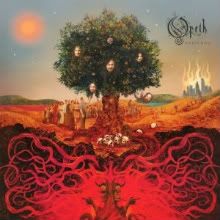
Album of the Month: Opeth – ‘Heritage’

I’m aware that I haven’t actually done an ‘album of the month’ post for a while, so this isn’t really a monthly thing. As September comes to an end though, I wanted to talk about an album that I’ve been waiting for for quite some time: Opeth’s ‘Heritage’.

I’ll make no secret of the fact that I’m a big Opeth fan. I have been for almost as long as I’ve been listening to metal (close to a decade now – wow, how can something make you feel so old when you haven’t even hit 25?!). ‘Heritage’ is their new album, and it’s both a departure from their usual sound and an Opeth album in every way.

Let’s start with the departure aspect. Opeth have always been, primarily, a death metal band with progressive leanings. ‘Heritage’ is very much not a death metal album, but instead something much closer to 60s/70s prog rock. There are echoes of King Crimson, ELP, Camel, Jethro Tull, even the Beatles. There are no death metal vocals, and lots of keyboards/acoustic guitars. In this respect, ‘Heritage’ and it’s accompanying live tours have made a lot of long-term Opeth fans very unhappy. They wanted metal. They got 70’s-style prog rock.

There’s another side to this album though, and one which strikes me as very much Opeth’s traditional sound. There is a strong resemblance in many of the acoustic guitar riffs to those on the band’s only other non-death metal album, ‘Damnation’ (and in fact to acoustic guitar riffs on many of their other albums). The prog elements on ‘Heritage’ may be stronger than before, but they’d already made an appearance on the last two albums, ‘Ghost Reveries’ and ‘Watershed’. ‘Heritage’ is, in many ways, a continuation and expansion of those two albums, but it’s lost the metal elements to achieve that. Whether that’s appealing has more to do with the listener’s attachment to metal, rather than whether or not Opeth have changed their ‘sound’.

It’s not a perfect album, admittedly. Some of the songs, particularly those in the middle of the album, are so complex that they never really have a chance to get going – just when your ear has attuned itself to one melody, that melody is gone and doesn’t reappear in the rest of the song. It could also be argued that ‘Heritage’ is something of a pastiche of 70s prog, although I think there’s enough of Opeth’s signature sound in there to avoid that.

Overall, it’s a very impressive album. ‘The Devil’s Orchard’ and ‘Folklore’ in particular are excellent songs, but it’s listening to the album as a whole, start to finish, that provides the most rewarding experience. Recommended for lovers of prog rock, or for metalheads who are looking for something a bit different.

This Writing Life: Writing That Doesn’t Drawn Attention to Itself

I’ve been reading a book recently that has made me think about writing style, and particularly a style that is so simple it hardly feels like a style at all. You see, this book is a long epic fantasy, twice the length of many things I’ve read recently, and yet I’m going to finish it in half the time it’s taken me to read some of those books. It’s nothing to do with liking the book more either (although it is very good). Instead, I’ve come to realise that the speed at which I’ve read has a lot more to do with the style in which the book is written.

In genre fiction, style isn’t something that gets discussed a great deal. Plot, pace, character – yes. Style – not so much. All books have a style, I think, but there’s something in genre fiction that frequently ensures this particular aspect is overlooked. Why? Well, it seems to me that style is overlooked because it’s supposed to be overlooked in these books; because it is writing that doesn’t draw attention to itself.

Now, of course there are some fantasy books, for example, where the style of the writing is almost as important as the plot. You’re supposed to notice the clever metaphors and words you’ve never heard before (I defy anyone to read an entire China Miéville book without having to look up at least one word in the dictionary).

Having said that, I think most genre fiction leans the other way. We find, instead, stories in which the plot and characters, magic and worldbuilding, are more important. To keep them to the fore of the narrative, the writing style is deliberately simple (simple, not simplistic), with few flourishes and clever devices. In these books, you won’t find yourself stopping to admire a carefully crafted sentence or simile, because you’re not supposed to. Instead, you’ll be up past midnight, desperate to reach the end of the book and find out what happens to these characters, and how they escape from a situation of mortal danger (or how the ‘happy couple’ end up together, or how the mystery is solved etc. etc.).

I’m not saying that having a recognisable style in your writing is a bad thing, nor that you should abandon all words with more than three syllables. However, in genres like fantasy and SF, where suspension of disbelief is so important for the reader, having a style that they can effectively ignore because they’re so invested in the story can be a good thing. Writing that doesn’t draw attention to itself is not the same as poor writing, and it can be one of the most important tools in a fiction writer’s toolkit.

Late Summer Reads

I realised today that, although I’ve talked a lot about writing recently, I’ve been remiss in saying much about what I’ve been reading. As autumn starts to draw in – and it really felt to arrive on the very first day of September here – I always feel a drive to read faster and get through a few more books, but here are some of the ones I’ve enjoyed this summer.

Servant of the Underworld – Aliette de Bodard        A fairly recent debut, Servant of the Underworld is something quite different in current fantasy novels. On her website, de Bodard describes it as ‘Aztec mystery-fantasy’, which sums it up nicely. The worldbuilding and historical background is miles away (quite literally, in this case) from your average European-based fantasy, and the magic system is fascinating. It’s also rare to find such a short book into which the writer has crammed so much plot and characterisation. There are no wasted words here, and the whole story is compelling from start to finish.

The Bone Palace – Amanda Downum        Downum’s Necromancer Chronicles has quickly become one of a very limited number of series that I absolutely have to buy the next book from as soon as it’s released. The Bone Palace doesn’t disappoint, and it’s interesting to see Isyllt back on home turf, dealing both with magic and with her personal life. As in the first book, Downum’s worldbuilding and language are lush and striking, and whilst her characters seem to be becoming increasingly broken, they’re always interesting to read about.

Green Rider – Kristen Britain        Green Rider is the first book in a series, of which the fourth has just been released. As a result, the whole series has just been reissued (or possibly issued for the first time?) in the UK, with some very attractive covers. I’m actually surprised I’d missed the series up to this point – it’s a NYT bestseller and the sort of epic-fantasy-with-strong-female-characters that I love. The beginning of the novel is very traditional quest fantasy stuff, but that changes somewhat in the second half, where the characters and the intrigue really come into their own.

The Tale of Murasaki – Liza Dalby        This one is something quite different for me: a historical novel, set in 11th century Japan. The whole book is beautifully written, quite slowly paced and utterly mesmerising. Far too few historical novels really conjure up a sense of a remote and very different world for my liking, but this one does exactly that, with Murasaki’s poems adding to the atmosphere.

Having written this, I’ve realised that the vast majority of the books I’ve read recently – and particularly the ones I’ve loved – have been by female authors. I have a few books in my To Be Read pile that might challenge that, though, including a Robert Holdstock novel (the second in the Merlin Codex), a Kim Stanley Robinson novel (Years of Rice and Salt) and MD Lachlan’s first book (I’m not usually drawn to werewolf books, but the idea of Viking werewolves is so brilliant that I have to read it).

This Writing Life: Re-evaluating This Year’s Goals

Over at Magical Words, there’s been a bit of talk lately about revisiting writing goals which were set at the start of the year. When I read those posts, it occurred to me that, after the first few months of 2011, I completely forgot to even look at my sheet of goals. I was too focussed on accomplishing the work I’d set myself to look again at what I’d envisaged that work would be.

There’s something about reaching September though, and realising that you’re two-thirds of the way through the year, that really sharpens your mind when it comes to goals. I find myself with a sense of urgency that wasn’t there before, and a desire to actually get things finished, so now is an excellent time to re-evaluate my earlier plans.

Having not looked at them for a while, I was a bit apprehensive, but I’ve found that I’ve actually stuck to my goals quite closely. Some are further along than I’d expected: I wanted to reach at least 50k words on a new novel by the end of the year, and I’m already at 35k. Conversely though, some of my goals have fallen behind: I really wanted to have started querying my finished novel by the middle of the year. In the end, editing it took much longer than I’d anticipated, and writing the synopsis and query has been a struggle. I might be querying by the end of September – but I equally might not.

What does this all mean for the rest of the year, and for next year? Actually, all it means is that I need to keep going in the direction I’m already heading in. All my work this year has stuck closely to my goals, so I don’t feel the need to either work on something different or make new plans.

However, those goals were, for the most part, supposed to have been completed by July. The fact that I’m still working on them now, and will be for the rest of the year, suggests I may have been a bit too ambitious in January. That doesn’t mean I’m going to be less ambitious next year – but it does mean I now have a better idea of what I can easily accomplish in 12 months, and how I can push myself harder in 2012.

A New Look

I’ve been considering for a while how best to update the look of this blog without doing anything too over-the-top, and I’ve finally started on the changes. First up is a new background, and there should be a bit of fiddling with fonts, colours and probably a new heading soon. Hopefully I’ll manage not to break anything!

So, have a look – particularly if you’re reading via an RSS feed and haven’t seen the actual blog for a while – let me know what you think, and do let me know if I have broken anything. I can’t promise I’ll be able to fix it, but I will find someone who can!

This Writing Life: The Fascination of Other Writers’ Lives

As an unpublished writer, I spend a lot of time looking at the websites and blogs of published authors. It always pays to be informed, after all. What new books are coming out? What sort of writing tips does this author give? Do they give contact details for an agent I might be interested in submitting to? All of this is valid and useful information for a new writer to be searching for, but I’ve found that there’s one particular part of authors’ websites that I always head to first: their bio page.

These can range, it seems, from a couple of lines detailing when their first novel came out and where they live, to a thousand words of family history, career history, how they got published etc. etc. Either way, I find author bios fascinating. The same goes for details of their lives that appear in blog posts and on Twitter. Talk about new book releases and competitions frequently turns me off – finding out how many words they wrote that morning or where they went on holiday is much more interesting.

Now, before this all sounds far too creepy, let me get to the point. I’ve realised there are two reasons why I’m so fascinated by other writers’ lives. The first is almost business-like. I love to know how they first got published, who by, who their agent is: maybe, just maybe, I’ll be able to follow a similar path to publication. Likewise, details of writing habits, and what software they use, and where they work might give me some tips to increase my own productivity. All writers work differently, and some methods will be so far apart as to be incompatible, but listening to and learning from other writers is a great way to make your own work better.

Then we get to the other bit: the eating habits and holidays and the like. This time, it’s a fascination not just with other writers, but with everyone. These seemingly meaningless minutiae are exactly the sort of facts you need to create convincing characters. What does my character like to eat for breakfast? Where’s his ideal holiday? What would he do if he won the lottery? And what, most crucially, do these little questions reveal about his personality – his hopes and fears, childhood and dreams for the future? Studying the lives of real people, be they famous historical figures or someone you’ve just met online, can add all sorts of fuel to the creation of your own characters.

So many parts of our lives are like this: filled with little hints and clues, ideas and possibilities that can make our writing stronger, more realistic, more believeable. Some carry whole stories in and of themselves. Learning to look for them all the time takes practice, but it’s also incredibly rewarding – even if it does start with reading on Twitter what someone had for breakfast.

This Writing Life: Working on the Edge of Understanding

Back when I was at school, studying for my A-levels, I distinctly remember something one of my English teachers told us. She was talking about finding her old thesis in the attic and reading it for the first time in years. “I know I must have got a good mark for it,” she told us, “because I can’t understand any of it now. I’m not even sure I understood it at the time.”

It was one of those offhand remarks that was to come back to me time and time again for years afterwards. It didn’t take me long to notice that, whilst I was at uni myself, I got the best marks for the essays in which I wasn’t entirely sure what I’d written. In these essays, I would inevitably have a good idea, but one difficult enough to understand that I wasn’t quite sure I grasped it myself. I would proceed to write it into my essay, and usually get a good grade. Even then, though, I wouldn’t always be entirely able to understand what my own brain had come up with – it was just a good thing that someone else did.

The same process, I feel, applies to writing. I get ideas – sometimes individual concepts, sometimes the whole, complex, intricate plots of novels – which I sort of understand, but not entirely. They feel to float somewhere just a little bit too high for me to reach. I can see them, I can even write about them, but I have to approach them at all sorts of strange angles and tangents. I can never look at the whole idea in one go, because then it becomes entirely incomprehensible. So, it’s a single line here, a character motivation there, and a plot twist to finish it all off.

It’s a strange business, I’m aware, and one that I’ve come to think of as ‘working at the edge of understanding’. I’m always pushing myself to come up with bigger, better, more compelling ideas. Sometimes they’re easy to grasp, but I think it’s the ones that aren’t that are the most important. These are the ones that force me to both improve my writing and my understanding of the world in general. I may never be able to fully articulate them, but in the process of trying – and sometimes failing – I’m constantly striving to push myself forward.

It’s the old adage, I suppose, of big failures being more important than small, unambitious successes. Rather than playing it safe all the time, we as writers need to be constantly pushing our boundaries, our understanding, our abilities. Because eventually, those ideas and skills that were beyond us once will be finally within our grasp, and that’s when we’ll have really improved.

Groping Blindly in the Dark

So, here I am: back from my lovely holiday in Cornwall, back at my desk, with what feels like the tail-end of summer outside the window and nothing to really interrupt my writing between now and Christmas. In some ways, that’s a wonderful feeling. I have a novel to be writing, after all (which passed the 25k words mark today), and it’s going well. That long, uninterrupted stretch to write it in will be great. The problem, though, is that working on just one novel tends not to be enough for me. Usually, I’ll be editing another at the same time, or writing short stories, or researching. This time though, all of those things have fallen a bit by the wayside, and so I’m left feeling as if I’m groping blindly in the dark for something to do.

I know what I should be doing, of course. I have a finished novel – I need to be writing my query letter, writing my synopsis and sending it out to agents. I’ve done a little of all those things, but now I’m stuck. How to know when my query letter is as perfect as I can make it? How to know whether the novel is even worth querying? How to know which agents to send things to in the first place? Groping blindly, once again.

I don’t really have a solution, or an answer to any of those questions. At the moment, my plan for the rest of the year is as follows: start querying the book by sending out a single query every week. Make sure I also have at least one short story out on submission at all times, too. Finish my proofreading course. And keep working on the new novel, with which I’m aiming for 5k words a week (and have stuck to that for a month now).

It would be really nice, sometimes, to have some great writing guru in the sky who would tell me – would tell us all – what to do. Write your query like THIS. End your novel like THIS. Send this story HERE and that story THERE. Sadly, no such guru exists, so we have to just keep going. Groping in the dark, trying new things. Sometimes failing, but sometimes, just sometimes, succeeding too.