This Writing Life: The Standing Desk, Part the 1st

Apologies, first of all, for my extended absence from the blog. Real life got in the way for a while – a job interview (and yes, I got the job!), a holiday, family commitments, gaming, and of course, writing deadlines (extended another month. Phew) – but it’s back to normal now. Well, almost back to normal. You see, I’ve decided to make a bit of a change to my writing life, which means that my office desk now looks like this.

I’ve blogged in the past about the health problems I’ve developed through writing, or more specifically spending a lot of time at the computer. I’ve been dealing with RSI for several years now, and I’m always on the look out for new ways to alleviate it (without, of course, giving up writing), particularly since my aching hand and wrist were recently joined by stiffness in my neck and right shoulder.

I decided these new problems were at least partly caused by my monitor being too low, causing me to hunch up over my desk without even realising I was doing so. Rather than just raise my monitor, though, I decided to go a whole step further and set up a standing desk. Not wanting to buy a whole new desk though, I looked for an alternative, and my end result can be seen in the photo.

The first part involved raising my monitor, using one of these. Whilst the arm is a large, heavy, almost over-engineered piece of kit, it gives me the flexibility to keep my monitor at eye-level whether I’m standing up or sitting down. At the moment, the stands for my keyboard and mouse are actually the box and polystyrene packaging that the monitor arm came in, but I’ll replace these if this whole set-up is still to my liking in a few weeks’ time.

So, how is the standing desk working so far? I’ve only been using it for a couple of days, so it’s impossible to tell yet whether my RSI and muscle aches will improve. So far I’m still in the adjustment phase: it’s clear that writing standing up is going to take a bit of getting used to, both in terms of how initially tiring it is and how far my keyboard is from my line of sight.

In the long term though, I’m hoping for all manner of health benefits, and it seems many writers feel the same – using a standing desk seems to be an increasingly popular option. Only time will tell, though, whether I’m going to be joining their ranks for good.
This Writing Life: For Love and Money

I think it’s fair to say that in the current ‘economic climate’ (as the media and politicians keep calling this great bottomless pit we’re staring into), there are plenty of people out there – myself included – who could do with a little more cash. Writing, at least of fiction, tends not to be a particularly profitable occupation, yet in times of hardship plenty of us – again, myself included – don’t put down our metaphorical pens. We’re doing this for the love.

It’s the idea of ‘for the love’ that is consistently bandied about in writing circles. It can be a frustrating thing to hear when it’s being spouted by a best-selling, millionaire author, but at the same time there’s a great deal of truth to it. The market moves quickly; the publishing industry is slow; writing a novel and subsequently selling it might take you ten weeks, or ten years. Even when you sell a novel, there’s no guarantee you’ll be able to live off the proceeds, which makes the idea of writing for money rather than love somewhat futile.

There’s the emotional side to it, too. Writing a novel is bloody hard work – writing something you hate because you think it’s going to make you money must be excruciating, especially if it then doesn’t sell. At least if you’ve spent ten years writing unsellable novels that you love, you won’t feel like you’ve wasted your time (or not quite as much, anyway).

And yet, there are a growing number of new writers who are convinced that, with the rise of e-publishing, they can make thousands selling ebooks. It’s true that some people can, and that it’s likely the majority of these books are being written, initially, for pleasure rather than economic reasons. Still, it doesn’t take a great deal of study of the publishing industry to know that most wannabe author superstars will never make more than a few hundred dollars, and some won’t even break even.

So, writing specifically for money is probably infeasible, whilst writing for love is worthwhile but will still leave you with bills to pay. It sounds like a hopeless situation – is there any possibility of love and money colliding?

Thankfully, I think there is. For a start, I’d bet that the vast majority of traditionally published fiction was written ‘for the love’, even if the author had a contract to fulfil. Loving your characters and the story you’re telling really shines through in a book, making your voice and your world come to life in a way that readers will both identify and appreciate. There are, too, an increasing number of non-traditional outlets for authors to sell their work, from the e-publishing arms of major enterprises to high quality self-publishing (some writers are making thousands on their own, remember).

We may be a way off salaries for writers, as China Miéville espouses, but I’m still hopeful. Be it with a traditional publisher or just selling ebooks on Amazon, there are and always will be ways for good writers to make money, whilst still writing books that they – and their readers – love through and through.

This Writing Life: Coasting

The last few weeks have been strange ones for me, writing-wise. I’ve been working consistently, but because I’ve been flitting between half a dozen different things (novel edits, research and first pages of another novel, a novella for an anthology etc. etc.), I don’t feel as if I’m getting anything done. As a result, I feel rather like I’m coasting along: not falling behind, not slacking off, but not really making progress either.

Even for an unpublished writer, I’ve discovered this is a life with an uneven schedule. You’ll be plugging away at a novel for months, only to feel bereft and directionless when it’s done. You’ll go from having no finished short stories and nothing to submit, to several done and needing submitting, in the space of a month – and when you do submit, you’ll hear nothing for weeks, before getting a flurry of responses. Interesting calls for submissions also seem to come in clusters, with a dearth of deadlines to work toward one month and three or four the next.

So, what to do in those periods when you feel to be coasting? It’s easy to just let the current drag you along – and that can be fine if you’re genuinely working, as I am – but sometimes you need to break free. Keep track of what you’re working on, how much you’ve accomplished, and what deadlines might suddenly loom up at you if you let them. You might find that you need to change tack and work on something else, or that you actually are on the right track (and if you are, congratulations! I never seem to be working on what I think I should be working on).

When coasting can, of course, be the right time to take a break, or to write something completely new, though of course that depends on what you’re abandoning to do so. You can easily feel as if you’re not making progress when right in the middle of a novel, but that’s one very good example of when not to pack it all in and do something else. Get the novel finished and then decide whether your work is taking the path you want it to – having that finished novel can make all the difference.

In my case, it’s a novella I’m currently plugging away at, and one which I started afresh this week (which is probably why I feel I have so little forward momentum). I can’t honestly tell at the moment whether this novella is going anywhere, or whether it’s going to be any good when it’s finished – I can only jump into that current and follow it downstream to the end, and start paddling harder as that deadline rushes towards me.

This Writing Life: Throwing Words Away

The Olympics are in their winding-down stages now, so I thought I’d take a break from my Not-Quite Cultural Olympiad (I had a couple more posts in mind, which I’ll get to if I have the chance next week). Instead, it’s back to writing, and something I’ve been thinking about his morning, namely throwing words away.

You see, I’m working on a novella, set in a world I’ve already written a novel about, but twenty years after those events.  All I have to go on for guidance is the world I’ve already created and a particular character (the novella is for a specific anthology, and this character is absolutely perfect for the anthology’s guidelines). I could, in theory and as long as my character stays in character, write about anything – which is turning out to be exactly the problem. I have too many choices, and none of them seem to be quite working.

And now we get to the heart of this post: I’ve written 5000 words on the novella this week, but this morning I decided the story just isn’t going as well as I’d like. Despite being up against a deadline, and with anything up to 40k words to write, I’m going to need to throw most of those initial 5k away.

I’m made similar decisions in the past, but this is the first time I’ve been fairly certain I’ll be unable to reuse any of what I’ve written so far. Instead, I’m looking at entirely different plots, which diverge so far from my ideas at the beginning of the week that that first 5k has become entirely meaningless. It’s a frustrating process, particularly with a deadline constraining just how much time I have to work on this novella.

Of course, I know that no writing is a waste of time. I’ve learnt more from this failure than from writing an opening I was perfectly happy with first time. Still, there’s something more annoying about throwing words away than there is about writing an entire story before deciding there’s no point editing it and putting it aside. In that instance, I can take the whole story as an educational exercise, which I can study once and then never look at again. This time round, despite throwing those words away, I’m not prepared to abandon the novella as a whole, and no matter what I’ve learnt, I can’t help but feeling I’ve been wasting time.

So, throwing words away: have you done it? And if you have, what’s the largest number of words you’ve discarded? My 5000 wasn’t too severe – I’m waiting for your horror stories!

This Writing Life: We Work Harder

I want to start off this post by sharing a music video. Go on, have a look (the video is a little strange, I admit, but the song is great).

[youtube http://www.youtube.com/watch?v=VH5vgng9LAg]

For anyone who didn’t want to watch, here are the lyrics that always grab my attention:

As these are hard times
We’ll work harder, harder
Through these hard times
I’ll work harder, harder

This particular chorus always grabs me, every time I hear it. Why? Because it feels, every time, like something of a battle cry, a call to arms for those of us who are struggling on through life, and particularly those of us who have chosen to try to make their way in creative industries.

After all, this is not a good time to be creative, we keep being told. Most of the western world is in a recession – even a depression. There are not enough jobs to go round, not enough homes to go round, not enough money to go round. And, if you’re a writer, you don’t need to read publishing blogs for long to be saddled with even more bad news. The publishing industry is dying! No wait, it’s already dead! There’s no money in self-publishing! Agents aren’t looking for new clients! Publishers don’t want new authors! And even if you do find an agent, even if you get published, there’s no money anyway, so you’d better be prepared to work for peanuts.

Ok, a lot of this is exaggeration and scare-mongering, though there’s of course a grain of truth in each of these statements. Even if you’re being positive, it’s clear that plenty of publishers are becoming more risk averse, plenty of agents are overburdened with too many submissions, and making any money out of writing at all – be it traditionally or self-published – is becoming increasingly difficult.

Here though, is where we come back to that song. ‘These are hard times’ it declares – they certainly are. But it’s not enough to just acknowledge that fact and let it run us down. Instead, we can only do as Patrick Wolf suggests: we’ll work harder.

Call it a battle cry, or just call it good old common sense, but looking at the state of the publishing industry – of the world – and despairing is no use to anyone. We need to write more, hone our work, pursue as many avenues of publication as possible. And if things get even worse, as there’s no guarantee they won’t? Well, I know what I’ll be doing. I hope you’ll join me.

This Writing Life: Novel Editing and Character Arcs

After my break last week, it’s back to work, and for me that means back to editing a novel. Last time, I wrote about my initial read-through of the first draft, and the copious notes I was making. This time, I’m moving onto the nitty-gritty of making sure each individual element of the novel works – and how to fix the bits that don’t.

I’ve already looked at the plot arc of the novel, and ascertained that it more-or-less works (using a handy synopsis-making tool in Scrivener, which I may cover in a separate post). For this particular novel, I’ve found it more important to look carefully at my character arcs: I have five POV characters, and I want to do my best to make sure their growth throughout the novel is consistent and, hopefully, satisfying.

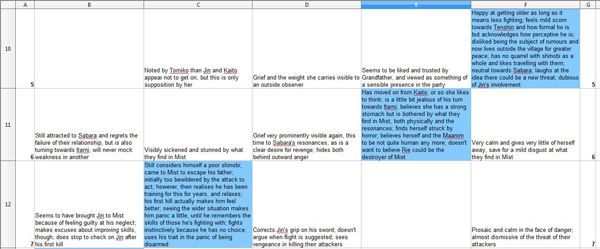
To do this, I’ve turned to spreadsheets. Not the most thrilling method in the world, perhaps, but laying out each character arc in sequence has been very useful, allowing me to see where individual arcs have perhaps turned aside, repeated themselves or even gone backwards (e.g. two characters who hate each other one chapter, make up in the next, and have mysteriously gone back to hating each other in a third, for no discernible reason).

In this example, you can see the five columns for the five characters, blue boxes denoting whose POV a chapter is, and my notes on how their character arc has progressed (which, depending on your eyesight, you may or may not be able to read!). The next stage – already nearly finished – was to work out how I wanted each finished arc to be (as opposed to how they are at the moment), and decide how each existing chapter needs to be tweaked to achieve that goal.

It’s been a complex process and one that, I have to admit, may have been more complicated than it needed to be. In developing each ‘new and improved’ character arc, I’ve come across only half a dozen places where major changes need to be made – most of the arcs will follow a very similar path in the final draft as they did in the first.

The difficulty, of course, is in knowing whether that means I got the characters right in the first draft, or whether I’m not making big enough changes in the edits. As to how to answer that… Well, I honestly don’t know at the moment. I can only hope that the overall, finished book is a success – and that’s something only readers and critiquers will be able to tell me!

This Writing Life: Always Creation, Never Destruction

There’s a lot of negativity – of destruction, to use the term I’ve put in this post’s title – in the world. Perhaps that goes without saying. On a smaller scale though, there’s also a lot of negativity in the publishing industry (and I’m not even talking about the whole ‘death of publishing’ cry that seems to whip round the internet every few months), and even just in the smaller-still world of SFF. This isn’t something that can be entirely avoided, of course, but perhaps there are things we can do to mitigate its effects.

If anything, there seems to be more negativity around at the moment than ever before. There are blogs that, although dealing with important issues – like race or gender in SFF – frequently do so in an acerbic, even vitriolic manner. Some are humourous – others seem to me to be simply destructive, adding little to important conversations about where the genre is heading. You can make all sorts of excuses, of course, such as these blogs are coming from a perfectly justifiable sense of anger, but that doesn’t mean they’re expressing that anger in the most useful or instructive way.

Then there are the perhaps more personal issues of authors imploding after bad reviews, and of scathing reviews left for all the wrong reasons (genuinely not liking a book is one thing – personally attacking the author because you don’t like the prices of their e-books is something else entirely). In the former, a brief flutter of ‘any publicity is good publicity’ can quickly turn into an author being black-listed for their unprofessional behaviour; in the latter, such reviews can be horribly upsetting for the targeted author, and quickly become nothing more than (pardon my French) shit-flinging, often using language that the reviewer would never dream of using to a person standing in front of them. There is a real person on the end of that email, or looking through their Google Alerts, though – too many people online seem to entirely forget that fact.

Then we have the separate issue (but one that I’ve been thinking about a lot recently) of grimdark fantasy, a sub-genre that seems to have dominated in recent years. I’m not saying all books should be sweetness and light – far from it, if they’re going to address important or difficult subjects – but many of these novels seem to feature violence and misogyny and general unpleasantness simply to seem more grown-up and ‘edgy’. In the end, all that grimness and darkness doesn’t mean anything, becoming nothing more than titillation.

So what’s the answer? For me, it comes back to that title – ‘always creation, never destruction’. When writing a bad review, or a difficult scene, that mantra becomes incredibly important. Does this review actually give constructive criticism, or illustrate a wider point – or am I just letting off steam? Is the darkness in this scene there for a reason and necessary to the plot – or am I just being mean to my characters because I’m having a bad day?

Negativity is, as I said before, a fact of life, and sometimes a very necessary one. However, sometimes it’s better to take a step back, look at that scathing or insulting or unpleasant thing you’re about to write, and really ask yourself whether it’s going to add something useful to the world – or if it’s just destruction for destruction’s sake.

This Writing Life: Editing and my Read-Through Notes

It’s not often that I blog about the editing and revising side of writing, for the simple reason that it’s my least favourite part of the process. However, last week I started what’s going to be a fairly major edit of my most recent first draft, so I thought I’d do a few posts about what I’m doing – and whether or not it ends up working.

I’m attempting, for the first time, to do this edit in a single pass, broken into two stages: a single read-through, and then a single round of edits, working through one chapter at a time. Whether I’ll actually be so efficient in the end remains to be seen. To start with though, I’m on the read-through stage.

So how am I going about it? First up, I converted my novel into .epub format, so it could be transferred to my e-reader. (As a useful aside, here, Scrivener’s ‘compile’ function allows you to convert a novel into any number of formats, including .epub. Whilst the end result might not be a perfect, sale-quality ebook – at least not with my rudimentary knowledge – it’s great for saving your work in different formats for your own use.)

Here you can see my work-in-progress ebook. There are some little niggles – including that strange double chapter heading with two different numbers – but that’s irrelevant for now. I’m simply using this ebook version as an easy way to read through my manuscript without straining my eyes, and with the option of working away from my computer.

More importantly, as I read, I make notes. I started my edit by looking back at my planning for the novel, reminding myself what I wanted to achieve, and making a list (I love lists) of everything I’d missed from the first draft but still want to have in the novel. This is a list I’ll return to again and again through my edits, to make sure this novel becomes everything I want it to be.

Next comes the read-through itself, making chapter by chapter notes of everything that’s wrong, needs fixing and just doesn’t make sense. You can see the first page of my chapter notes below.

To start off, I have the chapter number, the point of view character and a page number – which is high because I’ve continued my numbering from my first notebook, which contained all this novel’s planning and research. Having a single numbering scheme means I can cross-reference any other page and find it instantly, without having to work out which notebook it refers to first (it’s a little thing, but it’s amazing how much easier it makes my life!).

The notes themselves cover everything from mood and theme, to clunky parapraphs, to out-of-character moments and plot inconsistencies. These are all things I need to fix later. What do I not include? Too many details of typos, rubbish word choices and style issues. So much of the existing prose could be cut in the edits that noting down typos now is meaningless – I’ll pick up on them when I’m in the next stage of editing, typing up my changes chapter by chapter.

I’ve got a long way still to go on these edits, certainly, but I’m also feeling more positive about these revisions than any I’ve done before. Hopefully, if you’re also stuck in the editing mines, you’ll have picked up a few tips here – and in posts to come – that will make your life easier too.

This Writing Life: Is Your Hero A Bully?

I’ve been reading a book recently (which I won’t name, because I want to use it as an example of a larger point, rather than an exercise in author bashing), which has got me thinking about anti-heroes, and more specifically how they relate to the characters around them.

You see, in this particular book – billed as a ‘romantic fantasy tale’, no less – the female main character and the male main character (who both have POV) really get off on the wrong foot when they meet. Stories of lovers who start off hating each other are nothing new, but this book goes a bit further. In their first confrontation, the hero and heroine get into something of a fight. He insults her, spits at her, even drags her around by the hair. At the end of the scene, he does offer to help her, but grudgingly, and only because he needs her help in return.

So, the wrong foot, as I said. The relationship continues in much the same vein. I kept expecting – hoping, really – that the female character would stand up for herself a little more: that she’d kick the hero’s arse, deliver a rousing speech, even just spit in his soup (she cooks for him on several occasions). Instead, she shows her defiance in coldness and a straight back. Given that she’s scared of him but trying not to show it, that’s perhaps fair enough.

The real problem, though, comes from the hero and his POV. Given that this is supposed to be a romance, he really is nothing more than a bully. He continually insults the female character and is aggressive towards her (which is supposedly because he ‘does everything passionately’, and because he’s had a hard life – ‘extenuating circumstances’, if you will). He is angered by her apparent defiance, and immensely pleased when he finds out she’s scared of him. And when his feelings towards her start to soften, as is inevitable? It’s not because he starts to understand the heroine, or believe that she’s not actually loathsome after all. Instead, he becomes attracted to her. He still hates her, is still aggressive towards her – but he’d also quite like to have sex with her.

Now, I’ll admit I haven’t finished the book, and there could be a massive reversal before the end (I have flicked ahead though, and they do end up together). Still, after reading two-thirds of the story, I can’t help but think of it as anything more than a catalogue of abuse. No matter how often the author tries to show the hero doing the right thing, he’s consistently vicious towards the female main character, making the idea that they’ll get married at the end not far from abhorrent.

I’m not, in the end, trying to say that you shouldn’t write unpleasant characters. There are plenty of brilliant anti-heroes out there, both male and female. If your character needs to be a bastard, to have done horrible things, to be almost as terrible as the villain – then write the character that way. But if you’re trying to build a romantic relationship between two characters, no matter how opposed they might seem in the beginning? Please, don’t make your hero a bully.

This Writing Life: 3 Months + 120k Words = One Novel!

I wrote recently about coming to the end of a novel, and talked then in fairly general times. Today I want to talk a bit more specifically about the novel I’ve just finished. So, as the title suggests, it’s been three months and close to 120k words (120k was my goal – I came in at somewhere over 110k), and I have yet another finished first draft to add to my ever-growing collection. This one, though, is one that I actually still like, despite being glued to it for three months. I also think it’s one of the best things I’ve ever written. So, after tending to hate my first drafts when I’m done with them – or at least be terribly disappointed with them – what’s changed?

  • Planning.  I realised, when I set out to write this novel – codenamed ‘Root’, but only because I can’t think of a proper title for it – that it was going to be the biggest and most ambitious thing I’d ever written. 120k words. Five POV characters. A bigger geographical area than I’ve used in a novel in a long time. As well as knowing something about the ending in advance, I also needed to know how my many characters connected to one another, and as much about the world as possible. There were plenty of things that developed as I wrote, and some I missed out altogether (I realised towards the end that I’d created a world entirely without religion, which was a bit of an oversight, particularly in fantasy), but overall I planned more of this novel than any other I’ve written, and kept working on my planning and world-building as I was writing.
  • Characters I love.  Coming up with characters I really loved, and really knew through and through, was crucial to Root. I’ve made the mistake in the past of world-building thoroughly but knowing nothing about my main characters, but I’ve realised that just doesn’t work for me. I need to know who I’m writing about, even before I know anything about the plot, because they shapes everything that comes afterward.
  • Writing quickly.  I effectively doubled my writing speed with this novel, going from 1k words a day to 2k. I honestly never thought I’d be able to write so quickly, but it was one of those strange instances where pushing myself to write more actually made the whole process easier (just as I never get more done than when I’m already really busy). Getting from the start of Root to the end so quickly is, I think, the main reason I’m not sick of looking at it now.
  • General improvement in writing ability.  I’m fairly certain I’ve become a better writer since I last finished a novel. There’s always improvement to be made, of course, but being able to see a progression in my writing is very heartening. There’s nothing like knowing you’ve done absolutely the best first draft you currently can to make you feel really proud of a novel.
  • Enough plot for sequels.  This one was a bit of an accident, but I realised halfway through that Root was going to be the first in a series. I’ve never before written a novel ending that didn’t tie everything off – well, now I have. In some ways, that means I can’t be sick of this novel, because I know there’s so much more to come, and I’d love to have the opportunity to write it.

From this point, of course, it’s onwards and upwards: time to start a new novel, and to revise this one. I think it’s useful to look back when you’ve just finished a project, though – to congratulate yourself on what you’ve done well, and prepare yourself for doing even better next time.