This Writing Life: Setting the Tone in World-Building

I’ve been posting these Writing Life entries for some time now, and they typically reflect whichever stage of the writing process I’m currently at. However, my topics are nearly always something related to actually writing or editing – the early stages of planning novels and creating worlds I tend to keep to myself. Why? I suppose, in the past, there’s been a little part of me that’s worried about people ‘stealing my ideas’ – which is patently ridiculous, but is one of those little foibles all writers go through at one stage or another. I’m also aware that my process for world-building and starting novels is a) completely unsystematic, and b) different every time I do it.

Still, I’ll soon be writing the first draft of a new novel in an entirely new world, so I wanted to talk about how I got started with its creation. For me, concrete research comes later: at this stage, I’m focused entirely on developing the tone of my world in very broad strokes. That might include what rough, real-world time period the world will be based on; whether the setting is analogous to a real-world country or region; what the magic system might comprise in very general terms; whether the story will delve into the religion, or politics, or economy of the world I’m creating (I may well develop all three, but that doesn’t mean the plot will ever touch on them).

Now, it’s virtually impossible for me to start developing a novel with no idea of setting at all. The world, or at least some vague conception of it, usually comes to me before character, plot, or anything else. This stage of my world-building, then, involves taking that ‘vague conception’ and turning it into something concrete enough that I can start researching specifics. There are two main aspects to this: lots of notes, and lots of pictures.

The former means scribbling down every idea that occurs to me, no matter how ridiculous. Ideas for character, for plot, for details of the world – at this stage, all go down together, and each concept tends to strengthen others (deciding a character is going to use a certain type of magic means I have to find a place for that magic in my world, for example; and yes, character does often force the world in a certain direction at this point).

As I mentioned above, I often have a real-world time period or region in mind when pulling together my very early world-building ideas, and this is where pictures come in. A quick Google search will instantly give me images to help set the tone of my world. My latest novel, for example, started life with a sort of faux-Medieval Spain, so searching for images associated with ‘Medieval Spain’ instantly gives my world grounding. Will the finished setting be anything like the real Medieval Spain? Probably not, but at this point I’m just feeding my brain, giving it related information from which it can start building all the really juicy details.

As I write this post, I realise how hazy this process sounds (and why I haven’t blogged about it before!). It is hazy, even for me, but the key concept is simply this: gathering together as many inspirations as possible, then letting them swirl around together until more concrete ideas emerge. Additionally, it’s important not to discount anything at this stage. Trying to force your story and world in a certain direction can easily turn them into something stale and probably something you’ve seen done before, whilst letting your subconscious throw up ideas that feel completely disconnected can sometimes lead your story down avenues you’d never have considered otherwise.
This Writing Life: Music and Writing, Part 2

In my last post, I talked about music as a means of helping you to write, using it as a distraction, to improve concentration, or as a timer. Today, I’m looking at the other side of the equation: using specific music to help in the writing of specific projects.

It’s not uncommon to come across authors, particularly those writing series, who use music as inspiration or mood-setting. Certain songs will be associated with certain scenes, characters or locations – playing those songs immediately sets the tone and mood for writing about those things.

Now, I can’t tell you how to go out and pick a specific song for your protagonist, say. I’m not even sure you should. This is one of those situations where a song is much more likely to come to you at random, either because it gets stuck in your head while you’re writing said character, or reminds you of them when you hear it. Once you’ve found that song, though, listening to it can help you return to that character’s personality and thoughts, particularly when you’re struggling to capture them.

In the same way, music is a great tool for setting a mood more generally. I talked about Spotify playlists in my last post, and whilst I was referring to improving concentration for writing in general, there are several that set a much more specific mood. Perhaps your characters are going to a party and you want to hear what they’d be hearing and feel the same surge of adrenaline; perhaps you simply need to write a scene that’s joyful, or melancholic, or dark and angry. Finding music that evokes these emotions can be one of the quickest ways to translate that same emotion onto the page.

And then there are songs that are an inspiration in themselves. Songs often tell a story of their own (more on than in a future post!), and sometimes that story can spark ideas for your writing. As an example, the music and song titles from MONO’s ‘Hymn to the Immortal Wind’ album inspired me to write a short story filled with angry ghosts and snow-bound peaks; for some reason, those images simply popped into my head whilst listening to it (and it’s an entirely instrumental album, so that really was images conveyed through music). Other songs tell stories through their lyrics: certain lines from Vienna Teng’s ‘Blue Caravan’ send a shiver through me at every listen, and frequently make me imagine the world in which the featured character lives.

Music is just as personal a form of creativity as writing, and the same goes for listening to it. The emotions created in one listener will be entirely absent in another, or will call to mind something completely different. Learning which songs or artists trigger particular moods for you, or evoke certain characters, or simply tell stories that move you, can be invaluable for writers – they can be windows into worlds we wouldn’t otherwise have visited, and ways to revisit them when they otherwise seem lost.

This Writing Life: Writing and Music, Part 1

It’s fair to say that I’m a big fan of music. I’ve never played an instrument, but since my early teenage years I must have spent thousands of pounds on CDs, attending concerts, and various other music paraphernalia. (I did once do a rough estimate on what my CD collection had cost me up to that point; I think it came out at over £1000, and that was years ago, before I’d even left school.) I’ve been a semi-stalker/groupie of my favourite metal bands, I’ve travelled all over the country to see them play I’ve been to a festival in Germany twice, and there was a time when I was never out of a band t-shirt.

These days, I still attend gigs, still buy CDs and – most importantly for the purposes of this post – still glue myself to Spotify whenever I sit down to write. (Incidentally, if you want to know what I’ve been listening to recently, follow the link in the sidebar to my Last.fm page.) I’ve discovered, over time, that I can use music in a number of ways to actually make myself write, to improve my concentration, and to make myself write for longer.

Now, I know there are plenty of writers out there who need (or at least think they need) perfect silence in which to write. I might once have been one of them. However, by the time I was at university, I’d discovered that the rest of the world (a.k.a. everywhere that wasn’t the very rural landscape I grew up in) wasn’t very good at providing perfect silence. Music, then, became a way to block out other distractions and allow me to focus on my writing.

There’s one method, then: music as distraction. If the world around you is busy and frantic, putting on a pair of headphones with something soothing in them can be the perfect way to improve your mood and concentration. I’ve found Spotify particularly invaluable here, as they provide a number of ever-changing playlists designed specifically for these purposes (I’m listening to one called ‘Deep Focus’ right now – it’s almost entirely instrumental). Nothing lets me shut out the world quite like music, and with these playlists I can simply sit down at the computer, put one on, and think about nothing save the words on my page.

However, there are times when choosing a specific song or album can be equally invaluable. Sometimes that can be a means of providing a specific mood for a piece of writing, about which I’ll say more in my next post. When any music will do, though, I find putting on a full album particularly helpful when I’m struggling to focus on writing. This album is just 50 minutes long, I tell myself. All you have to do is sit here for 50 minutes and try to write something. No walking away from the computer until the album has finished.

Nearly always, by the time the music has finished, I’ll have written, and frequently find myself putting on more music to push myself for, say, another 50 minutes. You could use a timer in the same way, but I’m a bit of a stickler for listening to a whole album once I’ve started, so music works far better to keep me in my seat than a simple timer ever could.

So, I’ve talked about music as distraction, to improve your frame of mind, and to keep you in your seat. In my next post, I’ll be looking at specific music for specific projects: as a means of creating mood, getting into the heads of your characters, and even inspiring whole stories.

This Writing Life: Writing From Dreams

It’s fair to say that a lot of my writing attention has gone into a single world recently, namely the city of Ardom Wave which features so heavily in my first Ark & Fable novella (and in the sequel). Whilst considering writing a post about the creation of that setting, I started thinking about where the seeds for that particular idea grew from. When I remembered, I had to laugh: Ardom Wave came to me, quite literally, in a dream.

Now, I don’t usually pay much attention to dreams. Sometimes it’s fairly obvious what your brain is trying to tell you, and at other times it’s not worth trying to decipher the gibberish. Add to that the fact I rarely remember my dreams anyway, and you’ll realise I’m not about to suggest you start keeping a dream diary and mining it for every story you commit to the page. However, just occasionally, my sleeping mind provides me with something quite different, something I can quite clearly identify as a story, and something I might have come up with whilst awake.

These very rare dreams are, I find, like watching a film, start to finish. If I could write them down, I think they’d have a fairly coherent plot and be put together in the same way I’d usually plot a novel (I’m very visual when it comes to imagining scenes anyway, and I can usually describe the setting as though it were a film set). Of course, remembering that plot once awake is the tricky part, but I still tend to recall enough to build a story around what remains.

A couple of specific instances come to mind, here. One very much falls into that dreaming-an-entire-story category, and though I could only remember the last ‘scene’ once I woke, it left an incredibly striking image that I’ve been trying to work into a novel ever since. (In this particular instance, just that final scene provides both the entire setting and much of the plot leading up to it, and although I’ve written a nearly full draft of the story, it somehow didn’t work out as satisfactorily as I would have liked.)

And then we come to Ardom Wave. This time, there was no story, just a very clear image of a valley filled with pillars, attached to that name. I spent a good week convinced it was a setting I’d lifted from elsewhere, name and all, but Google revealed nothing and I came to the conclusion that the setting was one I’d imagined myself. Whilst the Ardom in the dream was an entirely natural landscape, turning it into a city for the Ark & Fable series seemed to come naturally, and has provided the perfect location to build those stories around.

As I said before, developing stories from dreams can be a haphazard business, and I certainly wouldn’t trust them to provide more than an occasional flash of inspiration. However, even that can be just what you need to spark an entire plot, character or world, so when your unconscious mind provides you with a helping hand, sometimes it’s wise to listen!

This Writing Life: Forgetting Stats and Sales

I’ve been talking a lot about self-publishing recently, and particularly about my own self-published works. Not surprisingly, a lot of my writing time has been dedicated to thinking about them, from the technical aspects of where to upload them and how best to go about promotion, to the more creative side of ‘what’s going to happen in the sequel?’. Something writers don’t talk about very often is that, no matter how calm and collected they might appear, there’s always worry associated with putting a new story out into the world. No-one wants to produce a flop. Everyone wants, no matter how modest they are about their own work, to be successful.

The thing is, in publishing at least, ‘success’ is both impossible to predict and difficult to achieve. Not only that, but one writer’s success is another’s abject failure. There’s no single recipe to great sales, a wide audience and lots of fans – and even if there were, that definition of ‘great’, ‘wide’ and ‘lots’ will depend entirely on the author in question.

This, then, is why I want to propose a new manner of working, one I’ve been thinking about more and more lately. Put simply: stop worrying about success. Or at least, success as defined by and relying on other people. Having writing goals is all very well, but as writers we’re constantly looking for the approbation of others. We want a certain number of sales, of blog views, of comments or reviews. These days, that even extends to numbers of Twitter followers and fans on Goodreads. These can be indicators of success, certainly (with sales being the biggest and most important in commercial publishing), but they’re largely things out of the control of the individual writer.

Despite that, of course, most of us spend an inordinate amount of time worrying about them. They take up time, and energy, and headspace as we try to deal with and then remedy them – time, energy and headspace that could be better spent. Better spent doing what, exactly? Well, you’re a writer. What do you think?

I’m not saying every writer should cease paying attention to the money they’re making and completely retreat from social media; if we want to publish in any sense of the world, we can’t exist in a vacuum. However, perhaps we shouldn’t be letting things we can’t control take over our lives, and instead focus on the things we can control. Not getting the sales you want? Write something else. No-one read your last blog post? Write another. No re-tweets of that really funny joke you just made? Start a conversation instead. Instead of worrying, and worrying, and worrying, turn your anxieties into writing, writing, writing. Not only will you feel better, but you’ll have produced something at the end of it – and that something might just be what brings you success after all.

This Writing Life: Staying Positive

I’ve been spending a fair amount of time on Twitter recently, in an effort to chat to other writers and keep up to date with publishing news. It’s working, for the most part, but I’ve also noticed a rather vocal sub-set of authors who never have anything positive to say about writing. At all. This ranges from continually complaining – in a rather passive-aggressive manner – that no-one ever reads their work (these are traditionally-published-by-a-large-press authors, I should point out), to grousing about how much hard work promoting themselves is and warning that publishing in general is doomed. I even followed a link to an article, published in a major online short story venue, about how dire every single aspect of a writing career – from just starting out to becoming a genuine celebrity – is.

Now, I know all these tweets and posts have a point. Being a writer, or indeed a creator of any variety, is hard; publishing, as we know it today, may well be doomed; promoting yourself online is a thankless task. I also understand that some of these authors are genuinely trying to help, by letting idealistic new writers know what the publishing industry is really like and what they should expect if they enter it. I’m glad, too, that writers who encounter racism, sexism, homophobia or any other prejudice are speaking out about it, no matter how depressing it may be to read. However, no matter how bad my day becomes, I just can’t bring myself to join these sometimes whiny, often disheartening, usually negative ranks.

Everyone has bad days, bad weeks, months or years. Ranting about it on the internet, though? I don’t know how much that helps. And whilst I can’t always promise to be a shining beacon of light, I’m pretty good at keeping my neuroses off-line these days, rather than opening them up to the world. I’ve talked before on this blog about how I prefer to keep my posts positive and that’s a personal guideline I’m sticking to, for a couple of reasons.

Firstly, I don’t think online whinging helps me, let alone anyone else. Dwelling on personal misfortune doesn’t accomplish much, other than making me miserable. I become less creative, less willing to engage with the world. Focusing on positivity is, therefore, a personal defence mechanism before anything else.

Secondly, though, I don’t believe dwelling on negativity really achieves anything on a wider scale. Pointing out a hateful post, then countering it with your own positive one and going on to promote something you love? That achieves something. Pointing out that hateful post, then listing every example of internet unpleasantness you can possibly dig out? What does that get you, other than a headache?

I realise this has turned out similar to another post I wrote recently, and that I’ve focused on internet negativity rather than general writing adversity. However, I find this is a subject close to my heart at the moment, and that however naive it sounds, I really wish more people online would spread a little positivity rather than constantly wallowing in the mire.

This Writing Life: A Spreadsheet a Day

This post is going to be a seriously geeky one when it comes to the nuts and bolts of writing, or rather how I function as a writer. I make no apologies for that. I’m a very methodical person, you see, and keeping spreadsheets (amongst other forms of records) is genuinely one of the ways I keep individual novels, my reading schedule and my entire writing progress on track. Do I use spreadsheets to their full mathematical potential? Not in the slightest. Do I have one for every subject I can conceivably put a number into (and a few I can’t)? Yes, absolutely.

First up is the most obvious one: keeping track of word counts. Now, there will be writers out there who don’t use word counts – some prefer pages, for example (useless to me, as I write in Scrivener and that doesn’t separate pages the way Word does) – but for many, word counts are the best way of keeping track of progress. I don’t keep charts for individual novels; instead, out of sheer curiosity as to how well my writing year is going, I track the number of words I’ve written in total.

This is one of those times when I could become infinitely finicky about keeping perfect statistics: I could record exactly how many words on each project, how many on blog posts, what time of day I wrote etc. etc. Instead, to stop myself falling into a black hole of numbers that won’t really help me, I simply write down the date, number of words written, the name of the project(s) and quick notes when I start or finish something – and at the bottom, a running total. It’s pretty basic stuff, but I can tell you that I’ve written 61019 words of fiction so far this year, and that’s the sort of heartening statistic that keeps me motivated.

My second big spreadsheet is my reading record. I’ve been keeping this since before I knew sites like Goodreads and Librarything existed, and again it’s fairly basic. However, not only does this allow me to keep track of where I’ve got to in various series (I frequently leave it years between volumes in long fantasy series, simply because there’s so much new stuff I want to read), but it’s a valuable place for me to jot down mini-reviews. Forcing myself to think about what I like and dislike about every single book I read, and then write that down in just a couple of sentences, has been invaluable in forming ideas about what I want my own fiction to be.

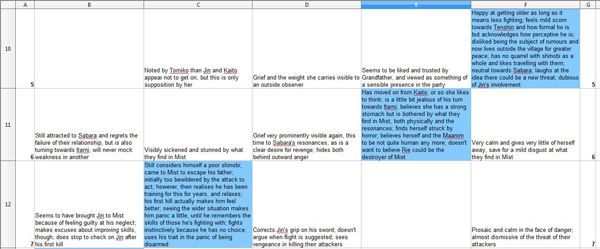
Finally, I’m going to share a picture I posted some time ago, when I was editing my last novel:

Here, I was keeping track of five different POV characters and their respective arcs; chapter numbers are down the left-hand side, and character names – although not visible in this screenshot – are at the top. Blue boxes denote whose POV each chapter is, whereas anything in white describes events happening to other characters in chapters not their own.

That sounds complicated, I know, but this was a complicated novel. Putting character arcs into neat lists like this, so I could see the events of the entire novel within just a few pages, was key to my edits running smoothly, and to being able to make sure each character evolved properly (without going backwards. as happened in the first draft!) over the course of the story.

As I said at the start of this post, many of my spreadsheets having nothing to do with numbers. Many of their functions could be achieved in other ways, too, possibly with all sorts of fancier software. However, these little beauties have helped me keep my writing on track, quickly and simply, in so many ways – and whether you’re already very organised or your filing system is basically ‘the floor’, I hope they can do the same for you!

This Writing Life: World-Building on the Fly

If you’ve been reading my recent posts, you’ll see that I recently self-published my first YA fantasy novel. It’s been a long time coming, and I’ll admit it’s shaken up my usual routine a bit, but it hasn’t changed one very important thing: I’m still writing. And, as usual, I’m attempting to write – or at least plan stories in – multiple different fantasy worlds, which I endeavour to keep as different from one another as possible (for my own sanity, if nothing else – both to keep myself interested and not get them confused). As a result, I’ve found myself thinking about world-building.

Now, that partly means poring over all the nitty-gritty details that can go into building a world, be that a fantastical one or a version of our own (every novel, no matter how ‘realistic’, portrays a different version of the real world, past or present). However, I’ve also been thinking about my process when it comes to world-building, and I’ve realised I’ve become drawn to creating settings ‘on the fly’, with as little prior planning as possible, simply to get myself into the meat of the writing quicker.

I usually have some notion of where a story is set, of course – it would be very difficult to write something without. However, I usually keep this quite vague e.g. Medieval Europe-style fantasy world, ruled by a single monarch, and with magic in the form of shapeshifting. Or, as another example: Medieval Japanese-inspired society, primarily within a vast forest which was once home to numerous other civilisations. Both of those are rather simplified versions of settings I’ve written in recently, and whilst the worlds have become more complex in the writing, these very basic synopses are the sort of vague starting points I began the stories with.

There are both pros and cons to this approach, of course. Of the latter, getting halfway through the novel and realising you really haven’t done much world-building is one, meaning your edits are going to be heavy on filling in the details of your world. However, it’s very, very difficult to write a story without building the world around it, even if you didn’t mean to. All the events – every conversation and conflict – have to take place somewhere, and whilst you may not go into great descriptive detail, the setting is still there and present in everything you write.

And the pros? World-building-itis is one of those syndromes that budding writers, particularly fantasy ones, often fall into. They spend months doing research, then more months meticulously crafting a world; when they finally come to write, their novel becomes more historical treatise than story as they struggle to fit everything in (if you’ve described every single bit of your setting in your novel? You’ve probably put too much world-building in at the expense of characters and plot). Developing your setting as and when you need to – what does this city my characters just rode into look like? who runs it? does it have any interesting customs or festivals that could become relevant to the plot? – saves a huge amount of time, allowing you to focus on writing rather than planning.

As ever, ‘on the fly’ world-building won’t suit every writer, just as the endless ‘plotting vs. pantsing’ debate rages on. However, next time you find yourself spending days working out every detail of a culture or location just to finish a single scene? Try world-building as you write, seeing what enters the story naturally, and save some of that brainpower for finishing the story!

This Writing Life: Why I’m Self-Publishing

Whilst the title of this post is fairly self-explanatory, I want to start with something of a disclaimer. Too often, I come across self-publishing blogs loudly declaiming the death of traditional publishing. No more big publishers! No more bookshops! No more BOOKS! Let’s just put our stuff up really cheaply on Amazon! In fact, let’s make it all FREE! Okay, so maybe I exaggerate a little, but you get the idea. So where’s the disclaimer?

Put simply, I believe the model outlined above is (pardon my French) bollocks. Self-publishing is great, but so are big traditional publishers – and everything in between. I would dearly love to become what I think is now being referred to as a ‘hybrid author’ i.e. someone who’s published via more than one method, often at the same time, and I’m actively working towards more than one avenue.

After that rather lengthy introduction, let’s get onto the main topic of this post: why I’m choosing to self-publish. The answer comes down to a single book, one I wrote several years ago on something of a whim. At the time, I was deep in the middle of my degree course and hadn’t written a word of fiction in over a year. I was desperate to write something fun, so proceeded to produce a novel into which I threw just about everything exciting I could think of. Once the book was finished, I put it aside – only to return to it a couple of years later when I decided to take Holly Lisle’s ‘How to Revise Your Novel’ course. Halfway through, I decided the book in question was far too short for an adult fantasy (it was), so I added something like 20k words.

I finished the course and time passed. I submitted the book to a couple of agents and got rejections (including one who said it ‘showed merit’, which is about as nice as rejections get). I put the book aside again and moved onto other projects: lots and lots of other projects, which ended up lasting several years. During this time, I realised that what I’d written was YA rather than an adult novel, but that in revisions, I’d only gone and made it 20k words too long – but also a better book in the process, meaning I was reluctant to take a backwards step and rip all that out.

At the start of 2014, I started looking back at old projects, deciding whether I wanted to resurrect any of them. I realised I had a decent, comprehensively edited book, that just so happens to be several rather unsaleable things: too short for adult fantasy, too long for YA fantasy, and a stand-alone (I have thought about sequels, but too much time has passed since the first one for me to really have any inclination to write them). Knowing all this, I wasn’t interested in sending the book out to agents and publishers again, but that didn’t necessarily mean no-one would be interested in reading it – and thus, my self-publishing experiment was born.

So, very soon I’ll be self-publishing this particular book (titled ‘Sanguine’ – more on that in my next post), as well as a handful of novellas (which I’ve written about previously). As you might imagine from my introduction, though, I have another novel still on submission to a publisher, which – if rejected there – will continue the merry-go-round of agents and publishers until it hopefully finds a home. It’s impossible to know whether I’ll be successful with either publishing route, but with more stories than I know what to do with, I can’t help but think both are worth a try!

This Writing Life: The Lure of the Novella, Part 2

In my last post, I talked about why writing novellas has become so appealing to me personally in recent months. Today, I want to look at novellas more generally, and why I believe right now is an excellent time to be writing them.

In traditional publishing terms, novellas are something of a hard sell. Most short fiction markets – even exclusively online ones – won’t take them, whilst it’s virtually impossible to get a novella in print with a major publisher unless you’re already an established name. There are occasionally anthologies which will take novellas, but even with an open call for submissions, only a handful are likely to be bought at once (beyond four or five, you’re really getting above what can be comfortably printed in a single volume, after all).

So, if traditional publishing isn’t much interested in novellas, why would anyone bother to write them? These days, there’s usually just one answer when anything that trad. publishing doesn’t want is involved: self-publishing. I recently had a browse of the top free ebooks on Amazon, paying attention not to genre, author or cover art, but to page count. A surprising number fell well below the 300 pages that I would normally associate with the minimum for your average commercially published novel, with many significantly below – anywhere from 70 to 200 pages.

It appears, then, that publishers not wanting to publish novellas and readers not wanting to read them don’t actually correspond. I’d hazard a guess that it’s a case of cost per book versus what a slimmer volume can be sold for that puts off print publishers; for readers, if a story is appropriately priced (and by that, I don’t necessarily mean free), its length isn’t much of an issue. Self- and e-publishing has allowed everything from flash fiction to massive, 200k+ word, multi-volume series to flourish, creating a market where there really is something for everyone.

All of which leaves self-publishing writers and their novellas in a very strong position. Compared to novels, novellas are much quicker to write and edit, so you can produce them more quickly and potentially build up a series of stories with a much smaller investment of time and energy (and it seems to me that it’s frequently the authors who are producing long series, with even as many as a dozen volumes, who are often the most successful at building a loyal readership). That smaller investment also means that if a story isn’t successful, it’s much easier to walk away, to move onto the next project and try something new. There’s also a smaller risk for potential readers, as novellas are quicker to read and generally less expensive, meaning they might be more likely to take a chance on an author they’ve never come across before – vital in a publishing world where there’s such a vast amount of choice.

Much of this is conjecture, I’ll admit, but it’s theory that I’m soon going to be putting into practice. I have not one, but two series of novellas I want to self-publish in the near future – and I’ll be reporting my progress every step of the way!