Amber: Getting Into Trouble Since 2012

It’s been a while since I’ve talked about my ongoing fan-fic for Chronicles of Tyria, but I thought it might be worth a mention today. My story over there is still going strong, and Amber – my asura thief – is still getting herself into an ever-increasing amount of trouble every fortnight. And when I think about what I’ve got planned for her over the next couple of months… Well, she’s in for quite a ride!

You can find links to Amber’s entire story HERE.

It’s also occurred to me that I’ve been writing this story since December 2012. 2012! I’m amazed it’s been so long, as the time has really flown by. However, there are now 30 episodes of Amber’s tale, which amounts to – at a rough guess – somewhere around 50,000 words of fiction. And it’s all free!

So, if you’re at all interested in Guild Wars 2, or indeed just free fiction (I don’t think the story is unintelligible for anyone who hasn’t played the game), have a look at Chronicles at Tyria. We’ve a whole wealth of excellent stories, which now include a web-comic and, as usual, a boat-load of videos and podcasts. And it’s all free, so what are you waiting for?

‘Star of the Everlasting’ Now Available

Late last week, I blogged about my forthcoming fantasy novella, ‘Star of the Everlasting’, the first in the Ark & Fable series. I’m pleased to say the novella is now available for purchase! Hurrah! For anyone who missed it, here’s the blurb:

In the cliff-top city of Ardom Wave, there are the nobles, the criminals – and those in between.

As middlemen ‒ or middlewomen, in their case ‒ Ark and her partner Fable tread the fine line between those in power and those most definitely not, all while keeping their heads down, staying ahead of the law, and always turning a profit.

Their ‘fine line’ is under threat, though, and Ark’s about to break her three cardinal rules. The first: never let a job turn personal, even when a face from your past comes calling. Lady Vesper might tug at Ark’s heart-strings, but as a noblewoman with a string of dead husbands, she’s a dangerous woman to get close to.

Except Vesper claims to have changed her ways and wants to escape the city ‒ an escape Ark would be willing to provide, if it wasn’t for rule number two: stay well away from magic.

Because Vesper is up to her elbows in the artifact trade, and if Ark is going to dig her out, she’ll have to break the most important rule of all, the one separating the middlemen from everyone else. She’s going to have to get her hands dirty.

To see the cover, and a few more details of the story, have a look at my previous post on the subject here. And, more importantly, to find the book on Amazon, go HERE.

It’s exciting to have another story out there in the world, particularly one that I hope will be the first in a series. I’m also experimenting with Amazon’s KDP Select program, in an attempt to give the novella an initial boost. There is of course a caveat there: the novella will only be available for the Kindle, at least for now, but if you’re not a Kindle owner, don’t despair! As with ‘Sanguine’, I’m happy to send out review copies in your choice of format – just leave a comment on this post, or send me an email (details on my About page).

It’s fair to say I love this series: I love the city (although I wouldn’t want to live there!), I love how much fun I had writing it, and I especially love the two central characters. If you fancy reading about ancient magic, crime capers and gun-fights, all with a twisty, twisty plot, I hope you’ll love them too.

This Writing Life: Forgetting Stats and Sales

I’ve been talking a lot about self-publishing recently, and particularly about my own self-published works. Not surprisingly, a lot of my writing time has been dedicated to thinking about them, from the technical aspects of where to upload them and how best to go about promotion, to the more creative side of ‘what’s going to happen in the sequel?’. Something writers don’t talk about very often is that, no matter how calm and collected they might appear, there’s always worry associated with putting a new story out into the world. No-one wants to produce a flop. Everyone wants, no matter how modest they are about their own work, to be successful.

The thing is, in publishing at least, ‘success’ is both impossible to predict and difficult to achieve. Not only that, but one writer’s success is another’s abject failure. There’s no single recipe to great sales, a wide audience and lots of fans – and even if there were, that definition of ‘great’, ‘wide’ and ‘lots’ will depend entirely on the author in question.

This, then, is why I want to propose a new manner of working, one I’ve been thinking about more and more lately. Put simply: stop worrying about success. Or at least, success as defined by and relying on other people. Having writing goals is all very well, but as writers we’re constantly looking for the approbation of others. We want a certain number of sales, of blog views, of comments or reviews. These days, that even extends to numbers of Twitter followers and fans on Goodreads. These can be indicators of success, certainly (with sales being the biggest and most important in commercial publishing), but they’re largely things out of the control of the individual writer.

Despite that, of course, most of us spend an inordinate amount of time worrying about them. They take up time, and energy, and headspace as we try to deal with and then remedy them – time, energy and headspace that could be better spent. Better spent doing what, exactly? Well, you’re a writer. What do you think?

I’m not saying every writer should cease paying attention to the money they’re making and completely retreat from social media; if we want to publish in any sense of the world, we can’t exist in a vacuum. However, perhaps we shouldn’t be letting things we can’t control take over our lives, and instead focus on the things we can control. Not getting the sales you want? Write something else. No-one read your last blog post? Write another. No re-tweets of that really funny joke you just made? Start a conversation instead. Instead of worrying, and worrying, and worrying, turn your anxieties into writing, writing, writing. Not only will you feel better, but you’ll have produced something at the end of it – and that something might just be what brings you success after all.

‘Sanguine’ Now on Libiro

I may have been busy working on my new Ark & Fable series of novellas, but I’m also determined to get my YA fantasy ‘Sanguine’ onto as many ebook sites as possible. (I do keep meaning to include Smashwords in that, incidentally, but it just looks more complicated than any of the other sites and I keep putting it off.)

Today I’ve added Libiro to the list, an ebook store dedicated to books by indie and small press authors. It’s a really nice site and very easy to use – and even provides a choice of ebook formats for readers – so I’d highly recommend it if you’re looking for something different to read this summer. It’s also been a pleasure to use as an author, which is always a plus!

So, without further ado: Sanguine, available now on Libiro, for your reading pleasure!

‘Star of the Everlasting’ Cover Reveal!

It’s only been a couple of months since my self-publishing début, but I’m never one to let the grass grow under my feet (unless it comes to actually mowing the lawn, at which I’m very lazy…). ‘Star of the Everlasting’ started life as a short story back in December of 2012. However, I have a real problem writing short stories, in that I continually try to cram too much plot in. By the time this particular story was at 12k words, I had to admit it really wasn’t going to be ‘short’ at all, and that to make it work, it needed a bit more room to breathe.

And the result is here! That unnamed short story became ‘Star of the Everlasting’, the first novella in my Ark & Fable series. It’s got gun fights and ancient magic and a city built on colossal stone pillars. It’s also got Ark and Fable themselves, the titular characters, a pair of ‘middlemen’ who negotiate between criminals and the city’s highest echelons, always in the name of profit. Well, perhaps not always, as you’ll discover if you read the novella…

So, on to the cover!

I think my partner has excelled himself this time, and I absolutely adore this cover. It’s dark and moody, and really sets the tone for the setting as a whole. It also shows a key scene from the story… and that’s as much as I’m going to say about that! However, you might have noticed the little logo in the middle of the cover, which – close up – looks something like this:

This was my partner’s idea, much as I’d like to take credit for it, and a version will appear on each novella in the series, tying the covers together.
Finally, it’s time for the blurb (not necessarily the final blurb that’ll make its way into the ebook, but it’s close enough):

In the cliff-top city of Ardom Wave, there are the nobles, the criminals – and those in between. As middlemen – or middlewomen, in their case – Ark and her partner Fable tread the fine line between those in power and those most definitely not, all while keeping their heads down, staying one step ahead of the law, and always turning a profit.

A fine line that comes under threat when they’re faced with conflicting requests from two equally wealthy clients, either one of whom could cause serious trouble if they don’t get their way.

The way out requires breaking Ark’s three cardinal rules. The first: never let a job turn personal, even when a face from your past comes knocking. Vesper might tug at Ark’s heart-strings, but as a noblewoman with a string of dead husbands, she’s a dangerous woman to get close to.

Except Vesper has changed her ways and is looking for a way out of the city – a way Ark wouldn’t mind providing, if it wasn’t for rule number two: never get involved in magic.

Because Vesper is up to her elbows in the artefact trade, and if Ark is going to dig her way out, she’s going to have to break the most important rule of all, the one that separates the middlemen from everyone else. She’s going to have to get her hands dirty.

You might have guessed that ‘Star of the Everlasting’ is rather different from my last self-published book. Whilst ‘Sanguine’ was a YA novel, this is firmly in adult territory (although, in all honesty, I don’t write huge amounts of sex, graphic violence or swearing in anything), set in a very different world. It’s also the first in a series, and I’m going to be trying a few different things when it comes to publication. For the first few months, at least, it’s going to be an Amazon exclusive, so I can gauge if that makes any difference to initial sales (I’ll say more about this when I do a more general self-publishing post). I’ll also be trying to get the next couple of novellas out as quickly as possible, with a novel-length omnibus to come later.

So, there you have it: ‘Star of the Everlasting’, coming soon to Amazon, and setting in motion events for a whole string of stories. I’ll have more release details soon, but for now, enjoy the cover, and let me know what you think!

When I’m Not Writing, Part the Second

A few months ago (more than I care to count, actually), I posted here about what I was up to when I wasn’t writing. It’s fair to say that, over the last two weeks especially, ‘not-writing’ has taken up far too much of my time, and will probably continue to do so for another week at least. This is bad news, obviously, but there’s always a silver lining, and today’s is HERE.

If you follow that link – and I hope you will – you can read all about the guest house my partner and I have just opened, here in the beautiful North Yorkshire countryside. There are even pictures! Of sheep! (Okay, the sheep pictures may be placeholders until web designer a.k.a. boyfriend finds something more suitable, but they’re rather cute anyway.)

All joking aside, getting this business venture off the ground has taken nearly a year, now. It’s been draining, utterly exhausting, and there have been times when I wished I’d just stayed in the city and worked for peanuts for the rest of my life (I really enjoyed my last job, and the people I worked with were truly fabulous, but it’s fair to say that the pay was… mediocre). However, making any kind of big change is always tough, and I’m glad we did it for the much-improved lifestyle it’s given us – although the prospect of actually opening our doors to guests is both imminent and terrifying!

When will my writing be back on track? Er… Still working on that one. The really difficult renovation work is behind us, but running a business of any kind is stressful, and that doesn’t always incline me to write. However, I’m hoping for a little more time over the coming weeks, which will be a blessed relief and should allow me to get a few more words down, both here and in my WIP.

I’m also hoping for a chance to get my next ebook up on Amazon, so keep an eye out for that. ‘Star of the Everlasting’ is on its way!

This Writing Life: Staying Positive

I’ve been spending a fair amount of time on Twitter recently, in an effort to chat to other writers and keep up to date with publishing news. It’s working, for the most part, but I’ve also noticed a rather vocal sub-set of authors who never have anything positive to say about writing. At all. This ranges from continually complaining – in a rather passive-aggressive manner – that no-one ever reads their work (these are traditionally-published-by-a-large-press authors, I should point out), to grousing about how much hard work promoting themselves is and warning that publishing in general is doomed. I even followed a link to an article, published in a major online short story venue, about how dire every single aspect of a writing career – from just starting out to becoming a genuine celebrity – is.

Now, I know all these tweets and posts have a point. Being a writer, or indeed a creator of any variety, is hard; publishing, as we know it today, may well be doomed; promoting yourself online is a thankless task. I also understand that some of these authors are genuinely trying to help, by letting idealistic new writers know what the publishing industry is really like and what they should expect if they enter it. I’m glad, too, that writers who encounter racism, sexism, homophobia or any other prejudice are speaking out about it, no matter how depressing it may be to read. However, no matter how bad my day becomes, I just can’t bring myself to join these sometimes whiny, often disheartening, usually negative ranks.

Everyone has bad days, bad weeks, months or years. Ranting about it on the internet, though? I don’t know how much that helps. And whilst I can’t always promise to be a shining beacon of light, I’m pretty good at keeping my neuroses off-line these days, rather than opening them up to the world. I’ve talked before on this blog about how I prefer to keep my posts positive and that’s a personal guideline I’m sticking to, for a couple of reasons.

Firstly, I don’t think online whinging helps me, let alone anyone else. Dwelling on personal misfortune doesn’t accomplish much, other than making me miserable. I become less creative, less willing to engage with the world. Focusing on positivity is, therefore, a personal defence mechanism before anything else.

Secondly, though, I don’t believe dwelling on negativity really achieves anything on a wider scale. Pointing out a hateful post, then countering it with your own positive one and going on to promote something you love? That achieves something. Pointing out that hateful post, then listing every example of internet unpleasantness you can possibly dig out? What does that get you, other than a headache?

I realise this has turned out similar to another post I wrote recently, and that I’ve focused on internet negativity rather than general writing adversity. However, I find this is a subject close to my heart at the moment, and that however naive it sounds, I really wish more people online would spread a little positivity rather than constantly wallowing in the mire.

This Writing Life: A Spreadsheet a Day

This post is going to be a seriously geeky one when it comes to the nuts and bolts of writing, or rather how I function as a writer. I make no apologies for that. I’m a very methodical person, you see, and keeping spreadsheets (amongst other forms of records) is genuinely one of the ways I keep individual novels, my reading schedule and my entire writing progress on track. Do I use spreadsheets to their full mathematical potential? Not in the slightest. Do I have one for every subject I can conceivably put a number into (and a few I can’t)? Yes, absolutely.

First up is the most obvious one: keeping track of word counts. Now, there will be writers out there who don’t use word counts – some prefer pages, for example (useless to me, as I write in Scrivener and that doesn’t separate pages the way Word does) – but for many, word counts are the best way of keeping track of progress. I don’t keep charts for individual novels; instead, out of sheer curiosity as to how well my writing year is going, I track the number of words I’ve written in total.

This is one of those times when I could become infinitely finicky about keeping perfect statistics: I could record exactly how many words on each project, how many on blog posts, what time of day I wrote etc. etc. Instead, to stop myself falling into a black hole of numbers that won’t really help me, I simply write down the date, number of words written, the name of the project(s) and quick notes when I start or finish something – and at the bottom, a running total. It’s pretty basic stuff, but I can tell you that I’ve written 61019 words of fiction so far this year, and that’s the sort of heartening statistic that keeps me motivated.

My second big spreadsheet is my reading record. I’ve been keeping this since before I knew sites like Goodreads and Librarything existed, and again it’s fairly basic. However, not only does this allow me to keep track of where I’ve got to in various series (I frequently leave it years between volumes in long fantasy series, simply because there’s so much new stuff I want to read), but it’s a valuable place for me to jot down mini-reviews. Forcing myself to think about what I like and dislike about every single book I read, and then write that down in just a couple of sentences, has been invaluable in forming ideas about what I want my own fiction to be.

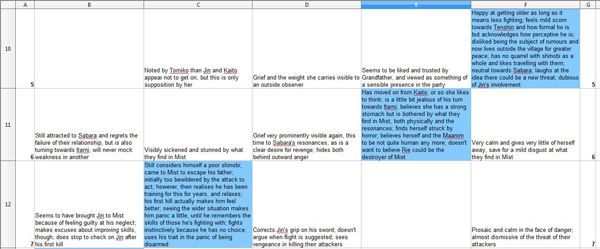
Finally, I’m going to share a picture I posted some time ago, when I was editing my last novel:

Here, I was keeping track of five different POV characters and their respective arcs; chapter numbers are down the left-hand side, and character names – although not visible in this screenshot – are at the top. Blue boxes denote whose POV each chapter is, whereas anything in white describes events happening to other characters in chapters not their own.

That sounds complicated, I know, but this was a complicated novel. Putting character arcs into neat lists like this, so I could see the events of the entire novel within just a few pages, was key to my edits running smoothly, and to being able to make sure each character evolved properly (without going backwards. as happened in the first draft!) over the course of the story.

As I said at the start of this post, many of my spreadsheets having nothing to do with numbers. Many of their functions could be achieved in other ways, too, possibly with all sorts of fancier software. However, these little beauties have helped me keep my writing on track, quickly and simply, in so many ways – and whether you’re already very organised or your filing system is basically ‘the floor’, I hope they can do the same for you!

SANGUINE now on Kobo

I feel a little as if I’m spamming my own blog (if that’s even possible) with links to my new profiles and new ebook at the moment – until I remember that’s actually called self-promotion and it’s a) quite useful if you ever want to have any readers, and b) a perfectly legitimate thing to do on your own blog. But y’know, I’m both British and female, so actually talking about ‘something I’ve created’ in public makes me want to dive into the nearest hedge for cover.

ANYWAY. Enough of that. Here’s the news: you can now buy Sanguine for the Kobo! Hurrah! I absolutely adore my Kobo and would probably read everything on it if I didn’t have such an obsession with buying actual books (which I then feel obliged to read, for some strange reason), so it’s very exciting to be able to offer my novel on a device I love so much. This is also, as I mentioned in an earlier post, an alternative for those who are currently (or permanently) avoiding Amazon due to their shady tactics in the bookselling business. I’m not entirely sure whether the Kobo version will work on other e-readers, but it’s supposedly being sold as a DRM-free .epub, so I have a feeling it should (if I can confirm that either way, I’ll update this post).

If you’re a Kobo owner, though, and fancy a slice of YA fantasy replete with assassins, illusionists, necromancy and blood magic, please head over here. I think you might like what you find.

This Writing Life: World-Building on the Fly

If you’ve been reading my recent posts, you’ll see that I recently self-published my first YA fantasy novel. It’s been a long time coming, and I’ll admit it’s shaken up my usual routine a bit, but it hasn’t changed one very important thing: I’m still writing. And, as usual, I’m attempting to write – or at least plan stories in – multiple different fantasy worlds, which I endeavour to keep as different from one another as possible (for my own sanity, if nothing else – both to keep myself interested and not get them confused). As a result, I’ve found myself thinking about world-building.

Now, that partly means poring over all the nitty-gritty details that can go into building a world, be that a fantastical one or a version of our own (every novel, no matter how ‘realistic’, portrays a different version of the real world, past or present). However, I’ve also been thinking about my process when it comes to world-building, and I’ve realised I’ve become drawn to creating settings ‘on the fly’, with as little prior planning as possible, simply to get myself into the meat of the writing quicker.

I usually have some notion of where a story is set, of course – it would be very difficult to write something without. However, I usually keep this quite vague e.g. Medieval Europe-style fantasy world, ruled by a single monarch, and with magic in the form of shapeshifting. Or, as another example: Medieval Japanese-inspired society, primarily within a vast forest which was once home to numerous other civilisations. Both of those are rather simplified versions of settings I’ve written in recently, and whilst the worlds have become more complex in the writing, these very basic synopses are the sort of vague starting points I began the stories with.

There are both pros and cons to this approach, of course. Of the latter, getting halfway through the novel and realising you really haven’t done much world-building is one, meaning your edits are going to be heavy on filling in the details of your world. However, it’s very, very difficult to write a story without building the world around it, even if you didn’t mean to. All the events – every conversation and conflict – have to take place somewhere, and whilst you may not go into great descriptive detail, the setting is still there and present in everything you write.

And the pros? World-building-itis is one of those syndromes that budding writers, particularly fantasy ones, often fall into. They spend months doing research, then more months meticulously crafting a world; when they finally come to write, their novel becomes more historical treatise than story as they struggle to fit everything in (if you’ve described every single bit of your setting in your novel? You’ve probably put too much world-building in at the expense of characters and plot). Developing your setting as and when you need to – what does this city my characters just rode into look like? who runs it? does it have any interesting customs or festivals that could become relevant to the plot? – saves a huge amount of time, allowing you to focus on writing rather than planning.

As ever, ‘on the fly’ world-building won’t suit every writer, just as the endless ‘plotting vs. pantsing’ debate rages on. However, next time you find yourself spending days working out every detail of a culture or location just to finish a single scene? Try world-building as you write, seeing what enters the story naturally, and save some of that brainpower for finishing the story!