The Part-Time Writer: An Introduction

When somebody says, “I’m a writer”, what do you picture? Maybe it’s a millionaire knocking out bestsellers every three months, getting them all optioned by Hollywood; maybe it’s a starving twenty-something living in a Paris garret, writing a single line every day of their Great American Novel. Or maybe, just maybe, it’s an office worker hammering out chapters in their lunch break, a mum working at the kitchen table whilst her kids are asleep, a librarian or a doctor or a teacher, getting up an hour early every morning to type a few bleary paragraphs before work.

The truth of the matter is that very few writers, professional or amateur, write fiction full-time. Many have day-jobs they dream of leaving. Others have a job they love, and writing is just a hobby. Still others write both for work — ad copy or magazine articles or blog posts — and as a passion in the evenings. For every job you can think of, there’s probably a writer out there doing it, whilst spending their free time (and maybe some of their work time) thinking up plots and characters, scribbling notes, and wishing they were at their keyboard. The one and only thing they all have in common, whether they keep their day-job voluntarily or out of necessity? They write.

I’m just one of these writers. My ‘day-job’ (or maybe that should be ‘first job’, as it’s not one with regular hours) is running a B&B with my partner. Some days, particularly during the summer, writing seems like a distant dream; others, I have nothing to do but write. I’ve asked myself time and again whether, should my writing career ever take off, I’d give up my day-job entirely, but it turns out that’s not an easy question to answer — until it actually happens, anyway.

So, for now, I’ll continue to write in my spare time, be that full days or snatched half hours. I will, like the majority of other scribblers out there, be a part-time writer — and that’s what this new series of blog posts will be about. There’ll be tips and tricks, things I’ve discovered for myself or picked up elsewhere. There’ll be techniques for writing more, writing faster, and making better use of your time. There will also be a few posts about why we do what we do: about motivation and passion, about the pleasure (or not) of writing, and about what makes this a life so many of us just can’t give up.

Because, for now at least, I’ll continue to be a part-time writer — and if you are, too, I hope you’ll join me for the ride.

TO DROWN IN DREAMS Now Available!

I mentioned in my last post that I’d been editing the second book in my Flight of the Lady Firene series, and sure enough, it’s now available on Kindle. Here’s the blurb:

Arjipur: a jungle haven built by pirates, exactly the sort of place Fleet Manteios and her brother Daryus should feel right at home – and somewhere they could make their fortune, if half the city wasn’t out for their blood.

Not only has Daryus made enemies by dabbling in the trade of the semi-magical drug gilgesh, but he and Fleet are about to run into an old enemy. Caria Maharin is an enforcer and head of the notorious Midnight Division – and she’s also the former owner of the airship Lady Firene. Nor is she the only one with an interest in the ship, or its crew: Arjipur has a new admiral, commandeering airships in the name of a war against an unknown enemy, and he’s got the Lady in his sights.

As Fleet fights to protect her brother, her ship and the city, she’s faced with a conundrum of her own: there are two very different men in Arjipur, both dear to her, and she’s going to have to decide where her heart lies.

To Drown in Dreams small coverSteampunk fantasy adventure! Airships! General shenanigans! What more could you want? Oh, a link to find it on Amazon? And not just that? A free book? That second link, incidentally, is the first book in the series, and if you happen to visit this blog entry between the 28th of October and the 1st November, you’ll be able to download ‘The Sky Below’ absolutely free. I say again, what more could you want?!

Less excessive use of wild punctuation? Okay, I’ll give you that one.

This Writing Life: Writing Every Day… Or Not

I’ve long been a proponent of writing regularly, of keeping a schedule no matter how busy the rest of your life might be. Maybe that’s writing every weekday, or every weekend; maybe that’s just one night a week, jealously guarded. In any case, having that routine allows you to write reliably and steadily, to set deadlines, and – importantly – to finish things. However, in the past I’ve also accompanied a regular schedule of production with time off, anything from a day or two each week to longer periods, time to think and relax and sort of breathe, away from whatever I’m working on.

This year, though… This year, I decided to try something different.

Starting on the very first of January 2015, I set myself the goal of writing 1000 words a day, every single day of the year. For someone who was also running a new business, keeping animals and attempting to have just a little bit of a life, it was an extraordinary target – but, for the most part, I’ve succeeded. Between the start of the year and the middle of October, I wrote every single day bar one, and whilst on many occasions I didn’t reach that 1k, my overall word count ultimately averaged out at my goal.

It has, without a doubt, been incredibly hard, but also incredibly rewarding. Producing so many words over the course of 10 months or so has been not only a boost to the number of books I’ve been able to self-publish, but also very exhilarating. There’s nothing quite like writing, and writing at speed, to make me feel endlessly satisfied; that abundant productivity and creativity is thrilling like nothing else (well, without leaving the comfort of your desk, anyway!).

You might have noticed, though, I mentioned ‘the middle of October’ above. That’s because, in the last week, I’ve made the decision to drop my daily target altogether – in fact, for the last couple of days, I haven’t written anything at all. (Funnily enough, what I expected to be a liberating decision is one I’ve barely noticed, simply because I’ve been busy with other things; and, perhaps, because writing is never far from my mind, even when my fingers aren’t on the keyboard). So, what happened?

Well, for a start, that daily writing schedule, and particularly pushing for 1000 words each time, was frequently disruptive to everything else in my creative life. For months, I’ve ignored social media, this blog, promoting my books, and all sorts of other miscellanea. For a long time, that didn’t particularly bother me, as I felt it was a sacrifice worth making, and I might have gone on almost indefinitely; in the end, it was two other factors that forced my hand.

One was, quite literally, my hand. I’ve suffered from RSI in my right hand, wrist and arm for years, and whilst the general routine of writing every day didn’t seem to exacerbate it, recent stints of concentrated editing seem to have been particularly damaging. Secondly, that editing was a problem: trying to edit multiple books, alongside writing 1000 words a day, has been more of a challenge than anything else I’ve attempted this year. In the end, I knew I needed to edit in order to meet my publishing deadlines, but that meant I frequently fell behind with my word counts, and knowing I wasn’t able to claw my way back to my goal was more disheartening than helpful.

So, I’ve dropped the schedule, but I’d still say it’s been worth it, as an experiment if nothing else. I think I really just wanted to prove to myself that I could do something like this – and I have. Whilst I would, in a perfect world, have kept up my goals until the end of the year, I still feel an amazing sense of accomplishment over how much I did achieve, and I’ve been pleased to find just how much writing time I can tease out of a day, every day, even when I feel otherwise overwhelmed.

As I said, then, an experiment, and a successful one, even if ended a little early. In future, I’ll still aim to write far more days than not, and to keep up a schedule whenever possible – but also, for my health and my sanity, I’ll remember to take days off now and again, that editing is just as important as writing, and that, when I want to, I can accomplish anything I set my mind to.

THE SKY BELOW Now Available!

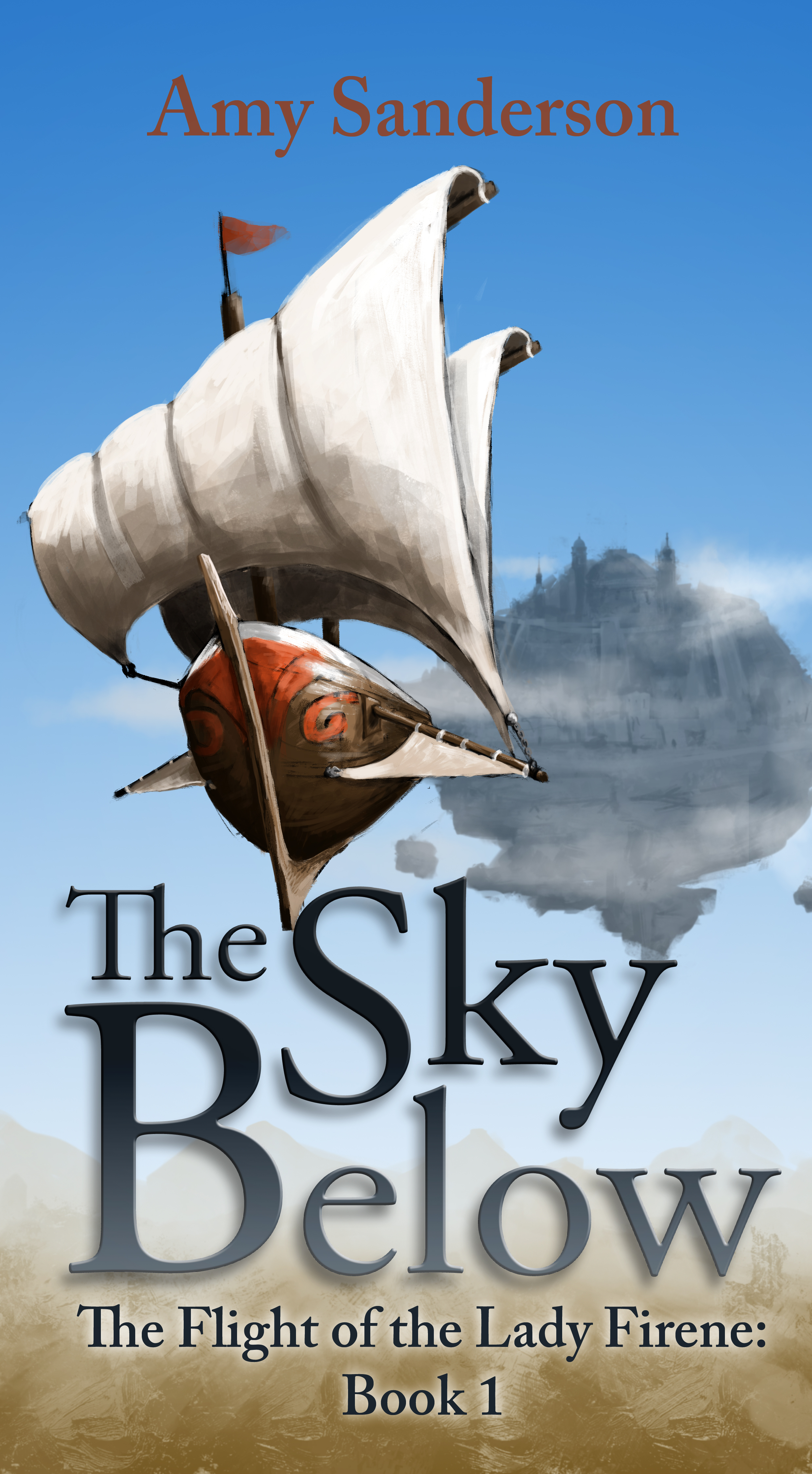
I’ve been holding off on my latest release for a few months now (I think I started mentioning it back in April), waiting until I had the second in the series almost complete. Finally, though, it’s time to share my newest series, a steampunk fantasy adventure titled The Flight of the Lady Firene. Each of the books will work roughly as a standalone, whilst continuing key characters and a few plot strands across the entire series. Below are the details of book 1, ‘The Sky Below’:

Flyingship2My name is Fleet Manteios and I’m a pirate. It’s a cut-throat life, sure enough, but it gives me the one thing I crave after a stuffy upbringing and a disastrous arranged marriage: freedom.

When Fleet and her brother Daryus raid the airship of a rival pirate, the last thing they expect is to end up fleeing for their lives with only a single trinket to show for it. A return to the floating city of Numara in the hope of a safe haven also turns sour, as the city comes under siege from within. Shape-shifting wolves, sea monsters, and strange murders committed by even stranger creatures plague Numara, and Fleet’s ‘trinket’ seems to be at the heart of it all.

Soon, she’s attracting the wrong sort of attention from every quarter: vengeful pirate captains, priestesses, her estranged husband – and the mysterious Shan, who knows more than he’s letting on. As Numara fractures around her, Fleet is left facing the possibility that the item she carries is the greatest threat she’s ever known, and it’s going to tear the city apart.

‘The Sky Below’ is currently available for Kindle only (which you can find here), but that does mean if you have a Kindle Unlimited subscription, you can read for free. If you’re not a Kindle reader (or you just fancy a free copy!), get in touch, as I’m happy to send out review copies of the book in other formats.

More Book News Than You Can Shake a Stick At

It’s been a busy summer for me so far, between actual day-job work and putting together as many ebooks as I can possibly squeeze out in the second half of the year. However, I haven’t been remiss at attempting to take over the world– Ahem. Extending my existing catalogue to as many places as I possibly can. Here are a few details:

First up, ‘The Wanderer’s Word’, a semi-historical fantasy short story.

The Wanderers Word for web

Where king and his conquered subjects collided, only trouble could follow.

England, 11th century. William of Normandy has taken the crown and is travelling in procession across a land he now rules, but which continues to resist him.

Alden, newly widowed blacksmith of a village barely worth a name, has greater cares than a single king. His world fell into tatters the night he lost his wife and child, and now his only concern is to protect their grave.

Except Alden’s family were denied a Christian burial, and the site he chose instead is under threat from the king’s men. He’s not the only one who would see that ancient and hallowed place protected, but if Alden is to gain their aid, he’s going to have to make a deal with the Old Spirits who still haunt the land – and he might lose more than he knows in the process.

The Wanderer’s Word is a 6000-word short story, and a glimpse of a historical England that never quite was – but easily could have been.

There’s the blurb, and here are the links. This one is Amazon only, for the time being, which also means you can pick it up via Kindle Unlimited, if you’re so inclined, at Amazon US and Amazon UK.

I’ve also been adding my first YA fantasy novel, ‘Sanguine’, to a few new stores. You can now find it at iTunes, and at the subscription services Oyster and Scribd.

Happy reading!

This Writing Life: The Perils of Writing a Series

Last night, I went to see the new Avengers film, Age of Ultron. It was a decent film, fast-paced and quite funny, but it got me thinking about stories told over a series and the perils inherent in that. The Avengers, after all, is the latest installment in Marvel’s series which now spans something like eight films with more on the way (a rough guess, because I haven’t actually counted them up properly!). Long-running franchises are nothing new in Hollywood, but perhaps where Marvel’s work is different is the way each film both stands alone and interconnects with everything that’s come before.

It’s a great idea, and obviously it’s been very successful, so what about those perils I mentioned earlier? In Age of Ultron specifically, I felt that Marvel’s franchise was beginning to groan under the weight of its own complexity. There were an awful lot of returning characters, and a lot of new ones to introduce – between the two, it sometimes felt like there wasn’t much room for a separate plot. Additionally, I can’t help feeling a new watcher would be completely lost at this point – if you haven’t watched every film in the series, Age of Ultron probably isn’t going to make a lot of sense (or, at the very least, you’re going to miss a lot of the nuances).

These same perils are very much on my mind at the moment, as I’ve just written the second in my Wayfarer Chronicles, and just started the second book in the Flight of the Lady Firene series. The latter will largely stand alone from the first book; the former, on the other hand, is much more a continuation of what came before. Deciding just how much background to include is a difficult line to tread. Do I fill in the reader on what came before and risk boring them? Or do I assume they’ve read – and, more crucially, remembered – the first book?

Like many writing topics, this is one of those things that comes down to the individual project. Some long-running series are so intertwined that you simply couldn’t start anywhere but the beginning (Wheel of Time or A Song of Ice and Fire, for example). Others provide multiple points of entry for the new reader, and can even be read in any order. There are even tactics somewhere between the two, as with the works of fantasy author Terry Brooks: he’s written multiple trilogies, all set in the same world, in which the books within the trilogies have to be read in order, but the trilogies themselves largely stand alone.

In the end, the possibilities for writing a series are both endless and a little bit terrifying. I’m sure there are many more perils I’ve yet to fully encounter (losing track of what’s come before, for one, and perhaps simply getting bored of writing the same characters for so long!), but for now I’m looking forward to adding depth to my already created worlds, to continuing stories where there’s more to tell, and writing characters that feel so real to me I’m almost dictating their words, not making them up as I go along!

SERVANTS OF THE NEXUS Now Available!

I’ve been busily working away on various ebooks and novellas recently, which means my new fantasy series, The Wayfarer Chronicles, is now here! The first novella, ‘Servants of the Nexus’, recently appeared on Wattpad, but is now available for download from Amazon, Kobo and B&N, with a few more sites coming soon. To find all the links, go here.

Or, if you need a bit more convincing first, here’s the blurb and the cover again:

wayfarers1There are a thousand thousand realms in the Nexus. Someone has to protect them from themselves – and each other.

As a Wayfarer, one of the immortal Kin, it’s Saenumandua’s job to police the illicit sale of information between worlds. Trouble is, only another Wayfarer could do the selling, and rogue Kin are dangerous beasts.

When one of them breaks into Saenu’s home, she’s left chasing a trail of clues that leads her to the city of Howl, a place of lumbering automatons and neon streets. With the aid of fellow Wayfarer Cam – and his guardian angel – Saenu must take back what was stolen and face an old foe, one who leaves nothing but devastation in his wake.

I’ve already finished the first draft of Book 2, still untitled, which will be available for download within the next couple of months. More details when I have them – for now, I hope you enjoy the first installment of Saenu and Cam’s adventures!

This Writing Life: Learning Your Daily Rhythms

I’m aware, as I start to write this post, that the title above sounds rather woolly. ‘Daily rhythms’ sounds like it should have something to do with yoga, or fitness, or even digestive health! However, the more times my writing schedule suffers an upheaval, the more I realise that there are certain rhythms to the writing day, and that taking advantage of them can increase your productivity quicker than any other method.

Back when I had a job with set working hours, I also had a strictly defined writing schedule. I’d get up every day (or every weekday, anyway), have a coffee and set to work. I’d usually aim for 2000 words a day, which would take most of the morning and possibly spill into early afternoon. After lunch, I’d maybe do some editing, or write a blog post, or simply take time off – and after that, I went to my ‘day-job’.

And then came self-employment, with all its concomitant pleasures and pitfalls. These days, I can have anything between zero and ten hours of ‘day-job’ work to accomplish in the course of a day, seven days a week. There’s not always a set pattern to this, either, which means some early starts and long days, and some lazy days where I might just do some baking or laundry. Around all this, I have to fit in my writing.

For months, I struggled to find not the time, but the motivation. When you’ve been on your feet for eight hours and finally sit down at the computer, the last thing you want to do is write, even if it’s only 3 in the afternoon. I’d frequently find whole afternoons and evenings wasted, as I simply couldn’t find the energy to commit words to screen, and whilst I got a lot of reading done instead, my word counts were nowhere near where I wanted them to be.

Eventually, though, I came to a realisation. The number of hours I’d already worked in a day was irrelevant; what mattered was when I tried to write.

My preference, still, is to write first thing in a morning, and I do this when I can. However, on busier days, I’ve also found I have something of a ‘second wind’ from about 6pm, when I find my concentration much improved (possibly because, by 6, I’ve usually eaten my evening meal and so have a lot more energy). Trying to write in that afternoon free-time, around 3pm, has turned out to be almost pointless. No matter what I’ve spent the rest of the day doing, I’m nearly always tired and lacking in concentration, which means I usually turn to reading instead.

That little switch – from trying to write at 3pm to actually writing at 6 – made a huge difference to me. Suddenly, I was able to sit down at the computer and start writing straight away, rather than wasting time on the internet for half an hour before giving up entirely. Working out when you have the most energy and the best creative concentration is absolutely vital for anyone who’s trying to fit writing around a busy work life – it’s the most consistent way I know to increase your word counts without feeling like you’re pulling teeth!

SERVANTS OF THE NEXUS now on Wattpad!

It’s been a quiet few months for me as far as fiction releases have gone, but I always knew I wasn’t going to get far into 2015 without publishing something – and right now, that something is ‘Servants of the Nexus’, the first story in my Wayfarer Chronicles, which I’ll be adding to throughout the year. First of all, here’s the fabulous cover:

wayfarers1

There are a thousand thousand realms in the Nexus. Someone has to protect them from themselves – and each other.

As a Wayfarer, one of the immortal Kin, it’s Saenumandua’s job to police the illicit sale of information between worlds. Trouble is, only another Wayfarer could do the selling, and rogue Kin are dangerous beasts.

When one of them breaks into Saenu’s home, she’s left chasing a trail of clues that leads her to the city of Howl, a place of lumbering automatons and neon streets. With the aid of fellow Wayfarer Cam – and his guardian angel – Saenu must take back what was stolen and face an old foe, one who leaves nothing but devastation in his wake.

To get the ball rolling, I’ve decided to post ‘Servants’ on Wattpad, a great site for free, serialized fiction. I’ll be putting up a new chapter ever Friday for the next nine weeks, at which point the novella will go up on Amazon, Kobo and similar.

If you’re already on Wattpad, have a read, and perhaps stop by and say hello – and even if you’re not, you should still be able to read the story. Free fiction! What’s not to like?

NaNoWriMo – What Next?

November is well and truly over, which means this year’s NaNoWriMo is now at an end. If you were taking part, how did you do? Was your novel a runaway success – or a complete flop? This year, I managed to stay on target right until the very end, squeaking over the 50,000 word mark on the 29th and taking a well-deserved break the day after!

Now that NaNo’s over though, what next? If you ‘won’, of course, now is the time to give yourself a pat on the back and probably catch up on some sleep. If your novel is actually complete, putting it aside for a while before revisions is always worthwhile. If, like me, that 50k was only a part of your estimated total, there’s obviously a lot more work to be done. I’m dialling back my daily word count for December, aiming for 1000 words a day instead of NaNo’s 1667 – but I’ll also be catching up on my serial fan-fic, starting on the editing notes for another novel, and posting the first few chapters of another serial story (more on that soon!).

So, what if you didn’t win? What if 50,000 words still seems like a dim and distant dream? The simple answer is: it doesn’t matter. It can be easy to get caught up in the fun and excitement of NaNoWriMo, but at the end of the day it exists to serve a single purpose: getting you to write. I get frustrated when I see people sharing NaNo ‘tips’ online, which essentially amount to easy ways of reaching 50k and nothing else. Spending pages and pages describing your character’s dress, or hair, or the view from their window is all very well when it comes to churning out words, but what use are those words going to be when November is over?

NaNoWriMo, then, is just an added incentive to write in November, not the ‘be all and end all’ of the writing year. Even if you managed just 500 words last month, those are words you didn’t have before, and now is the time – as it will be for next month, and the one after that, and so on – to add a few more to the total, with or without the forums, badges and shiny little graphs to keep you going.

I don’t begrudge people whose only interest in writing is to take part in NaNoWriMo every year and never touch a keyboard for the other eleven months. However, if it’s the writing you’re passionate about, not the competition, open up that manuscript again or pick up that pen. December is here – and we’ve got writing to do.