This Writing Life: Novel Editing and Character Arcs

After my break last week, it’s back to work, and for me that means back to editing a novel. Last time, I wrote about my initial read-through of the first draft, and the copious notes I was making. This time, I’m moving onto the nitty-gritty of making sure each individual element of the novel works – and how to fix the bits that don’t.

I’ve already looked at the plot arc of the novel, and ascertained that it more-or-less works (using a handy synopsis-making tool in Scrivener, which I may cover in a separate post). For this particular novel, I’ve found it more important to look carefully at my character arcs: I have five POV characters, and I want to do my best to make sure their growth throughout the novel is consistent and, hopefully, satisfying.

To do this, I’ve turned to spreadsheets. Not the most thrilling method in the world, perhaps, but laying out each character arc in sequence has been very useful, allowing me to see where individual arcs have perhaps turned aside, repeated themselves or even gone backwards (e.g. two characters who hate each other one chapter, make up in the next, and have mysteriously gone back to hating each other in a third, for no discernible reason).
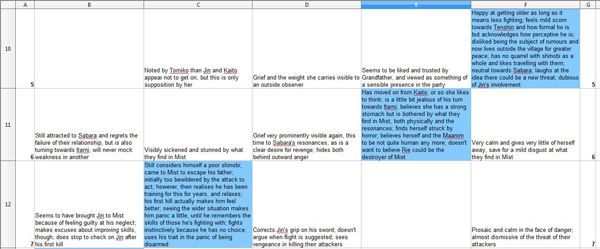
In this example, you can see the five columns for the five characters, blue boxes denoting whose POV a chapter is, and my notes on how their character arc has progressed (which, depending on your eyesight, you may or may not be able to read!). The next stage – already nearly finished – was to work out how I wanted each finished arc to be (as opposed to how they are at the moment), and decide how each existing chapter needs to be tweaked to achieve that goal.

It’s been a complex process and one that, I have to admit, may have been more complicated than it needed to be. In developing each ‘new and improved’ character arc, I’ve come across only half a dozen places where major changes need to be made – most of the arcs will follow a very similar path in the final draft as they did in the first.

The difficulty, of course, is in knowing whether that means I got the characters right in the first draft, or whether I’m not making big enough changes in the edits. As to how to answer that… Well, I honestly don’t know at the moment. I can only hope that the overall, finished book is a success – and that’s something only readers and critiquers will be able to tell me!

This Writing Life: Always Creation, Never Destruction

There’s a lot of negativity – of destruction, to use the term I’ve put in this post’s title – in the world. Perhaps that goes without saying. On a smaller scale though, there’s also a lot of negativity in the publishing industry (and I’m not even talking about the whole ‘death of publishing’ cry that seems to whip round the internet every few months), and even just in the smaller-still world of SFF. This isn’t something that can be entirely avoided, of course, but perhaps there are things we can do to mitigate its effects.

If anything, there seems to be more negativity around at the moment than ever before. There are blogs that, although dealing with important issues – like race or gender in SFF – frequently do so in an acerbic, even vitriolic manner. Some are humourous – others seem to me to be simply destructive, adding little to important conversations about where the genre is heading. You can make all sorts of excuses, of course, such as these blogs are coming from a perfectly justifiable sense of anger, but that doesn’t mean they’re expressing that anger in the most useful or instructive way.

Then there are the perhaps more personal issues of authors imploding after bad reviews, and of scathing reviews left for all the wrong reasons (genuinely not liking a book is one thing – personally attacking the author because you don’t like the prices of their e-books is something else entirely). In the former, a brief flutter of ‘any publicity is good publicity’ can quickly turn into an author being black-listed for their unprofessional behaviour; in the latter, such reviews can be horribly upsetting for the targeted author, and quickly become nothing more than (pardon my French) shit-flinging, often using language that the reviewer would never dream of using to a person standing in front of them. There is a real person on the end of that email, or looking through their Google Alerts, though – too many people online seem to entirely forget that fact.

Then we have the separate issue (but one that I’ve been thinking about a lot recently) of grimdark fantasy, a sub-genre that seems to have dominated in recent years. I’m not saying all books should be sweetness and light – far from it, if they’re going to address important or difficult subjects – but many of these novels seem to feature violence and misogyny and general unpleasantness simply to seem more grown-up and ‘edgy’. In the end, all that grimness and darkness doesn’t mean anything, becoming nothing more than titillation.

So what’s the answer? For me, it comes back to that title – ‘always creation, never destruction’. When writing a bad review, or a difficult scene, that mantra becomes incredibly important. Does this review actually give constructive criticism, or illustrate a wider point – or am I just letting off steam? Is the darkness in this scene there for a reason and necessary to the plot – or am I just being mean to my characters because I’m having a bad day?

Negativity is, as I said before, a fact of life, and sometimes a very necessary one. However, sometimes it’s better to take a step back, look at that scathing or insulting or unpleasant thing you’re about to write, and really ask yourself whether it’s going to add something useful to the world – or if it’s just destruction for destruction’s sake.

Back-Up Your Work!

You don’t have to frequent writing sites for long to come across someone who’s just lost their latest piece of work in a computer crash. On forums and blogs, Facebook and Twitter, there are plenty of people who’ve lost photos or music, films or ebooks, but when it’s your own work, and potentially something you’ve spent weeks or months on, that loss is even more catastrophic. Where I work, I’ve seen students in tears when they’ve discovered that they’ve saved their dissertation to the wrong folder before logging off, or the file has been corrupted, or they’ve left their USB stick in a computer and someone else has walked off with it.

Now, this is a particularly unglamorous side of the creative life, but just think about it for a minute. Imagine you’ve just lost a whole morning’s writing. Imagine you’ve lost the entire first draft of your novel. Imagine, even, that you’ve lost every single piece of writing you’ve saved on your computer, perhaps stretching back years. If, as a writer, that doesn’t make your blood run cold, then it’s likely nothing will.

It is, thankfully, incredibly easy to make sure these losses don’t happen, with just a little foresight and potentially a little money. You can save your work to a USB stick, to multiple computers, to external hard drives, to your email account. My personal favourite method, though, has been to sign up to not one but two cloud storage facilities, so that I can store my work on someone else’s secure servers, and ensure that even if every single computer, USB stick and hard drive I own is destroyed, I’ll still have access to everything I’ve ever written.

My first choice was Dropbox. Every piece of writing I create is saved into the Dropbox folder on my computer, and synced to their servers almost instantaneously. I’m using Dropbox’s free service, but have still found I’ve only used about 20% of that storage space with all my writing files. (As an aside, Scrivener recommends you don’t save its working files into Dropbox, so I instead create Scrivener back-ups twice a day or so, which are synced to Dropbox.)

I’m also currently using Crashplan. There a number of similar services available (Mozy and Carbonite seem to be two of the most popular) but Crashplan was my choice for its compatibility with external hard drives – where my huge collection of photos and music is saved – unlimited storage for a single PC and its general ease of use (namely allowing me to choose exactly which important folders I want to back-up, rather than attempting to sync every file and every preference from my computer).

So, there you go. It’s unglamorous, perhaps a little bit boring and might cost you $50 a year, but knowing your writing is backed-up, safe and secure from every possible disaster removes one unnecessary worry from the so many creative people saddle themselves with!

This Writing Life: Editing and my Read-Through Notes

It’s not often that I blog about the editing and revising side of writing, for the simple reason that it’s my least favourite part of the process. However, last week I started what’s going to be a fairly major edit of my most recent first draft, so I thought I’d do a few posts about what I’m doing – and whether or not it ends up working.

I’m attempting, for the first time, to do this edit in a single pass, broken into two stages: a single read-through, and then a single round of edits, working through one chapter at a time. Whether I’ll actually be so efficient in the end remains to be seen. To start with though, I’m on the read-through stage.

So how am I going about it? First up, I converted my novel into .epub format, so it could be transferred to my e-reader. (As a useful aside, here, Scrivener’s ‘compile’ function allows you to convert a novel into any number of formats, including .epub. Whilst the end result might not be a perfect, sale-quality ebook – at least not with my rudimentary knowledge – it’s great for saving your work in different formats for your own use.)

Here you can see my work-in-progress ebook. There are some little niggles – including that strange double chapter heading with two different numbers – but that’s irrelevant for now. I’m simply using this ebook version as an easy way to read through my manuscript without straining my eyes, and with the option of working away from my computer.

More importantly, as I read, I make notes. I started my edit by looking back at my planning for the novel, reminding myself what I wanted to achieve, and making a list (I love lists) of everything I’d missed from the first draft but still want to have in the novel. This is a list I’ll return to again and again through my edits, to make sure this novel becomes everything I want it to be.

Next comes the read-through itself, making chapter by chapter notes of everything that’s wrong, needs fixing and just doesn’t make sense. You can see the first page of my chapter notes below.

To start off, I have the chapter number, the point of view character and a page number – which is high because I’ve continued my numbering from my first notebook, which contained all this novel’s planning and research. Having a single numbering scheme means I can cross-reference any other page and find it instantly, without having to work out which notebook it refers to first (it’s a little thing, but it’s amazing how much easier it makes my life!).

The notes themselves cover everything from mood and theme, to clunky parapraphs, to out-of-character moments and plot inconsistencies. These are all things I need to fix later. What do I not include? Too many details of typos, rubbish word choices and style issues. So much of the existing prose could be cut in the edits that noting down typos now is meaningless – I’ll pick up on them when I’m in the next stage of editing, typing up my changes chapter by chapter.

I’ve got a long way still to go on these edits, certainly, but I’m also feeling more positive about these revisions than any I’ve done before. Hopefully, if you’re also stuck in the editing mines, you’ll have picked up a few tips here – and in posts to come – that will make your life easier too.

This Writing Life: Is Your Hero A Bully?

I’ve been reading a book recently (which I won’t name, because I want to use it as an example of a larger point, rather than an exercise in author bashing), which has got me thinking about anti-heroes, and more specifically how they relate to the characters around them.

You see, in this particular book – billed as a ‘romantic fantasy tale’, no less – the female main character and the male main character (who both have POV) really get off on the wrong foot when they meet. Stories of lovers who start off hating each other are nothing new, but this book goes a bit further. In their first confrontation, the hero and heroine get into something of a fight. He insults her, spits at her, even drags her around by the hair. At the end of the scene, he does offer to help her, but grudgingly, and only because he needs her help in return.

So, the wrong foot, as I said. The relationship continues in much the same vein. I kept expecting – hoping, really – that the female character would stand up for herself a little more: that she’d kick the hero’s arse, deliver a rousing speech, even just spit in his soup (she cooks for him on several occasions). Instead, she shows her defiance in coldness and a straight back. Given that she’s scared of him but trying not to show it, that’s perhaps fair enough.

The real problem, though, comes from the hero and his POV. Given that this is supposed to be a romance, he really is nothing more than a bully. He continually insults the female character and is aggressive towards her (which is supposedly because he ‘does everything passionately’, and because he’s had a hard life – ‘extenuating circumstances’, if you will). He is angered by her apparent defiance, and immensely pleased when he finds out she’s scared of him. And when his feelings towards her start to soften, as is inevitable? It’s not because he starts to understand the heroine, or believe that she’s not actually loathsome after all. Instead, he becomes attracted to her. He still hates her, is still aggressive towards her – but he’d also quite like to have sex with her.

Now, I’ll admit I haven’t finished the book, and there could be a massive reversal before the end (I have flicked ahead though, and they do end up together). Still, after reading two-thirds of the story, I can’t help but think of it as anything more than a catalogue of abuse. No matter how often the author tries to show the hero doing the right thing, he’s consistently vicious towards the female main character, making the idea that they’ll get married at the end not far from abhorrent.

I’m not, in the end, trying to say that you shouldn’t write unpleasant characters. There are plenty of brilliant anti-heroes out there, both male and female. If your character needs to be a bastard, to have done horrible things, to be almost as terrible as the villain – then write the character that way. But if you’re trying to build a romantic relationship between two characters, no matter how opposed they might seem in the beginning? Please, don’t make your hero a bully.

This Writing Life: 3 Months + 120k Words = One Novel!

I wrote recently about coming to the end of a novel, and talked then in fairly general times. Today I want to talk a bit more specifically about the novel I’ve just finished. So, as the title suggests, it’s been three months and close to 120k words (120k was my goal – I came in at somewhere over 110k), and I have yet another finished first draft to add to my ever-growing collection. This one, though, is one that I actually still like, despite being glued to it for three months. I also think it’s one of the best things I’ve ever written. So, after tending to hate my first drafts when I’m done with them – or at least be terribly disappointed with them – what’s changed?

  • Planning.  I realised, when I set out to write this novel – codenamed ‘Root’, but only because I can’t think of a proper title for it – that it was going to be the biggest and most ambitious thing I’d ever written. 120k words. Five POV characters. A bigger geographical area than I’ve used in a novel in a long time. As well as knowing something about the ending in advance, I also needed to know how my many characters connected to one another, and as much about the world as possible. There were plenty of things that developed as I wrote, and some I missed out altogether (I realised towards the end that I’d created a world entirely without religion, which was a bit of an oversight, particularly in fantasy), but overall I planned more of this novel than any other I’ve written, and kept working on my planning and world-building as I was writing.
  • Characters I love.  Coming up with characters I really loved, and really knew through and through, was crucial to Root. I’ve made the mistake in the past of world-building thoroughly but knowing nothing about my main characters, but I’ve realised that just doesn’t work for me. I need to know who I’m writing about, even before I know anything about the plot, because they shapes everything that comes afterward.
  • Writing quickly.  I effectively doubled my writing speed with this novel, going from 1k words a day to 2k. I honestly never thought I’d be able to write so quickly, but it was one of those strange instances where pushing myself to write more actually made the whole process easier (just as I never get more done than when I’m already really busy). Getting from the start of Root to the end so quickly is, I think, the main reason I’m not sick of looking at it now.
  • General improvement in writing ability.  I’m fairly certain I’ve become a better writer since I last finished a novel. There’s always improvement to be made, of course, but being able to see a progression in my writing is very heartening. There’s nothing like knowing you’ve done absolutely the best first draft you currently can to make you feel really proud of a novel.
  • Enough plot for sequels.  This one was a bit of an accident, but I realised halfway through that Root was going to be the first in a series. I’ve never before written a novel ending that didn’t tie everything off – well, now I have. In some ways, that means I can’t be sick of this novel, because I know there’s so much more to come, and I’d love to have the opportunity to write it.

From this point, of course, it’s onwards and upwards: time to start a new novel, and to revise this one. I think it’s useful to look back when you’ve just finished a project, though – to congratulate yourself on what you’ve done well, and prepare yourself for doing even better next time.

All Out of Brain Power

I’d been meaning to post twice this week, as the blog has been a bit quiet recently. But ah, the best laid plans, and all that. I seem to have completely run out of brain power, which I put down to finishing a novel last week and already being deep into the world-building and plotting for another. Then there’s been two weeks of gloriously warm – but tiring – weather, and extra shifts at work, and…

Actually, I’m just making excuses now. Suffice to say, my time and my concentration recently have been taken up with writing, and planning, and recuperating after a three month slog through a 120k word first draft (more on that next post).

So, because I’m all out of blogging inspiration, what is everyone else up to? What are you working on? What are you reading, listening to, watching, playing etc.? Let me know in the comments, and perhaps I can add a few more books, films and games to my ‘stuff to buy’ lists!


This Writing Life: A World from Scratch

As I bring one novel to an end (this week, if all goes to plan), it’s time for me to start thinking about the next. I tend not to think about sequels, or prequels, or stories in the same world when I start a new novel, because I always want to aim for something new and exciting. And when you’re writing fantasy, ‘new and exciting’ generally means building a new world, a secondary world, from scratch.

There are standard tropes in epic fantasy – the Medieval world, say, with wizards and kings and knights – but they’re not ones I’m particularly interested in writing about. In recent years, I’ve based aspects of my invented worlds on ancient China, Japan, and with my next novel, some combination of Persia, Egypt, Mesopotamia and the southern Mediterranean. How identifiable these historical real-world settings will be by the end of the novel differs with each project, but choosing the right background is generally how I start my world-building.

What comes next? In part, that depends on the project, but there are a number of aspects that are always useful to think about. Who’s in charge? What religion do these people follow? Where do they get their food? Who’s classed as an ‘outsider’ and how does that affect their life? There are perhaps an infinite number of questions you can ask when world-building, from religion and politics, down to whether there are public toilets, who empties them and what people use to clean their teeth.

Many of the answers to these questions might be found in study of the ancient society I’ve based my fantasy one on, but there can be other things to take into consideration. In fantasy, for example, magic is typically a major part of the world. Perhaps there are public toilets, but they’re magically cleaned by a never-ending spell every morning. Perhaps people use a similar spell to clean their teeth. Or perhaps magic exists at only the very top echelons of society, and there still have to exist men with muck carts and shovels, and the historical equivalent of toothbrushes for the masses.

Much of this world-building might never make it into the finished novel, but knowing your invented world as well as you possibly can is key to making it real for the reader. There can be a million things to think about, which sounds intimidating, but really doesn’t need to be. Some of my most intricate world-building has evolved along the way, rather than being planned out in the beginning – this is often the type of world-building that affects characters’ lives and really shapes the plot.

Still, whether you’re writing modern day romance or historical epic fantasy, world-building is one aspect of story you can’t ignore. My choice has always been to build my worlds from scratch, and enjoy every minute of making them as unique and interesting as possible.

This Writing Life: Levelling Up as a Writer

In my last post, I talked about coming to the end of a novel (about 20k words to go now, at last estimate). This particular novel is one that I only started a few months ago – on the 21st of February, to be precise. From the start of the first draft to the end, it will probably have taken me about three months to write. Now, from time to time, you hear about writers finishing books in a month, two weeks, even as little as ten days. Personally though – and I think the same can be said for many writers – I think completing a 120k first draft in three months is pretty damn good.

I’ve been making progress in other areas of my writing, too: more submissions (even if I haven’t sold anything), more finished short stories, more blogging. All in all, 2012 has started out quite well for me, and in many ways I feel as if I’ve ‘levelled up’ as a writer.

This is an analogy I’ve seen used before (I think most recently by Mur Lafferty). It’s a term that comes from gaming, and RPGs in particular (and I assume D&D too, though I’m not sure about that), referring to the player’s character becoming stronger, gaining more skills and abilities. As such, that character is then able to overcome more difficult challenges, continuing to get stronger all the while.

Perhaps it seems a little strange to apply a gaming term to real life, but it maps surprisingly well onto writing. How have I gained the extra experience? By writing more, getting more feedback on my work and constantly pushing myself to improve. What ‘new skills’ have I gained in the process? I’ve certainly become better at submitting my work, at editing, and hopefully at writing in general. And this hasn’t felt like a gradual process, but one that’s happened quite suddenly. Somehow, between finishing one piece of work and starting another, I’ve improved.

In writing, as in any numbers of activities, creative or otherwise, there’s a certain learning curve. Your early progress is often swift, as you develop entirely new skills. Once you have those skills, however, the process of refining them feels much slower – you hit a plateau. It’s something I’ve seen discussed by writers before, and seems to be one of those things you can experience again and again. The idea of ‘levelling up’ comes when you make that sudden, drastic improvement, overcoming the plateau and starting the next upward climb. Whether or not others can see the improvement in your work is almost irrelevant, when it’s something you can feel so decisively yourself.

The tricky thing is that knowing how to improve – how to get over that plateau – is almost as difficult as making the improvement itself. Whilst it’s important to push yourself when learning any creative skill, there are also times when that improvement just seems to come out of nowhere. Perhaps then, somewhere in your dreams, you killed that troll at the end of the cave, gained those last few experience points, and levelled up.

This Writing Life: Coming to the End

I realised as I wrote the title of this post that it sounded a bit ominous, or at the very least less than cheerful, but that’s actually rather appropriate. You see, today I want to talk about finishing novels.

As writers, finishing a novel (or a short story, or a screenplay) is what we’re all aiming for. It’s touted as a fantastic event, something to be celebrated – and it is. There are few things quite so satisfying as finishing a story for the first time, or the fifth, or the hundredth. I think there’s a thrill in it which never goes away, and it’s this thrill that’s most commonly talked about. When you finish something, you’ve taken your second big step as a writer (the first being starting something) – you’ve ‘levelled up’.

But there’s a less pleasant side to finishing a novel, one that’s not touted quite so often. For one thing, it’s exhausting. It doesn’t matter whether you’ve taken five days or five years over your story, you’ll still be tired at the end. So tired that writing anything else might feel like a distant dream, and revising that just-finished manuscript even more so.

Ah yes: revisions. I know some people love the editing stage, but for me it’s always hard work. It takes organisation, and ruthlessness, and a fine attention to detail, and for me these were skills that took much longer to develop than the sheer determination needed to finish my first drafts. Even if you love revising, it can still be as exhausting as writing the story was, and it’s just one more stage in a very long process. You don’t have to have written many stories to realise that first draft is called the ‘first’ for a reason – there’s so much more to come.

Finally, there’s something of an emotional wrench that comes with finishing a story, or coming close to the end of one, as I am now. Your characters, your world – at least for the time being, you have to put them aside (unless you’re going to be one of those writers who just keeps going on a never-ending first draft, millions of words long, but I wouldn’t recommend it). Maybe you’re actually sick of the book – in which case you’ll be dreading revisions even more – or perhaps, like me at the moment, you’ve loved writing it so much that you’re beginning to wish you were still somewhere in the middle.

Perhaps this is an overly negative post. I certainly don’t want to persuade anyone not to finish their novels. However, there are all sorts of difficulties involved in coming to the end of a story, and considering them ahead of time – do I know how the plot’s going to wrap up? have I left enough time before my deadline to put the damn thing aside for a while, so I’m not sick of it during revisions? do I have more stories in mind, so I don’t wake up one day and have nothing to write next? – can make that ending a little bit smoother, and a little bit more pleasant.